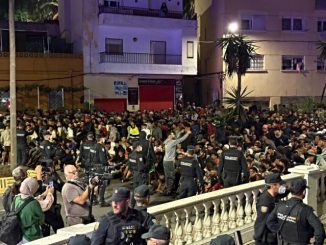
Moment Moroccans march through Ceuta and clash with police
Reported by:

Cherry Meigh Timbol
News Content Editor
Published August 3 , 2026
A major migration crisis erupted in Spain’s North African enclave of Ceuta after thousands of people crossed from Morocco, leading to clashes with Spanish police, emergency deployments, and renewed tensions over border security and migration policy.
The sudden influx overwhelmed local authorities and triggered a large-scale response from Spanish security forces. Officials said many migrants were influenced by false information circulating online about easier entry into Spanish territory, while authorities worked to restore control of the border area.
Large-Scale Border Crossing Triggers Emergency Response
The crisis unfolded after a large number of migrants attempted to enter Ceuta from Morocco by land and sea.
Key developments included:
- Thousands of migrants gathered near the border area before attempting crossings.
- Spanish police responded as crowds entered the enclave, with some confrontations reported.
- Emergency services and security forces were deployed to manage the situation.
- Many migrants were later returned to Morocco following coordination between Spanish and Moroccan authorities.
The incident revived memories of previous migration crises involving Ceuta, which has repeatedly become a focal point because of its location on the edge of Europe.
 Migrants clash with police on Sunday in Ceuta
 Migrants carry a fellow migrant, who they say was injured when the Spanish police and military tried to contain the migrants to an area of a beach
 Spanish National Police officers carrying batons charge towards migrants
 A police officer uses a baton to strike a migrant during clashes between migrants and police
 An injured migrant lies in the street after clashes during a demonstration in Ceuta
Spain Strengthens Border Security
Spanish authorities moved quickly to reinforce security around Ceuta.
Measures included:
- Deployment of additional police and military support.
- Increased monitoring of border areas.
- Efforts to process and return migrants who entered irregularly.
- Plans to strengthen physical barriers and coastal security. 4
Officials said maintaining control of the border while addressing humanitarian concerns remains a major challenge.
Tensions Between Spain and Morocco
The incident increased diplomatic pressure between Madrid and Rabat.
Spanish officials accused Morocco of failing to prevent the mass crossing, while analysts pointed to the possibility that migration flows were influenced by political tensions between the two countries.
Morocco has previously been accused of allowing migration pressure to increase during periods of diplomatic disagreement with Spain, although the issue remains politically sensitive.
 Clashes between migrants and police in Ceuta
 A migrant, who others say was injured when the Spanish police and military tried to contain migrants to an area of a beach, lies on the ground
 Migrants, many of them from Sudan, settle down for the night on Playa del TrampolÃn in Ceuta on August 2
 Migrants, many of them from Sudan, take part in evening prayers on Playa del TrampolÃn in Ceuta
Humanitarian Concerns Grow
The crisis also raised concerns about the safety and conditions faced by migrants.
Reported impacts include:
- Dangerous sea crossings resulting in deaths.
- Overcrowding and pressure on local services.
- Families separated during the movement of large groups.
- Increased humanitarian demands on authorities and aid organizations.
Human rights groups have called for balanced responses that protect both border security and migrant safety.
Political Debate Across Europe
The Ceuta crisis has intensified discussions about migration policy across Europe.
European governments are debating:
- Stronger external border controls.
- Cooperation with neighboring countries.
- The role of misinformation in triggering migration movements.
- How the European Union should respond to sudden migration emergencies.
The event has also fueled political divisions, with some groups demanding stricter migration policies while others emphasize humanitarian protections.
👥 Public / Political Reactions:
🇪🇸 Spain
Spanish authorities called for stronger border control measures after the mass crossing attempt in Ceuta.
- Government officials defended the actions of police forces responding to clashes at the border.
- Authorities emphasized the need to protect Spain’s territorial integrity while managing humanitarian responsibilities.
- Officials called for continued cooperation with Morocco to prevent future large-scale crossings.
➡️ Position: Spain is prioritizing border security, public order, and stronger coordination with Morocco to manage migration pressures.
🇲🇦 Morocco
Moroccan authorities faced pressure over the movement of large groups toward the Ceuta border.
- Officials worked with Spanish counterparts to control the situation and manage returns.
- The incident renewed debate over Morocco’s role in preventing irregular migration toward Europe.
- Authorities stressed the importance of cooperation while facing domestic and regional migration challenges.
➡️ Position: Morocco is balancing border control responsibilities with diplomatic relations and regional migration concerns.
🏛️ Spanish Political Parties
The incident intensified political debate over migration policies in Spain.
- Right-wing parties called for tougher border enforcement and stricter migration measures.
- Government supporters argued that cooperation with Morocco and European coordination are essential.
- Political groups debated how Spain should balance security concerns with humanitarian obligations.
➡️ Position: Spanish political debate is focused on border protection, migration control, and national security priorities.
🇪🇺 European Union
European officials monitored the crisis as another challenge for Europe’s migration system.
- EU members are concerned about pressure on external borders.
- Officials emphasized cooperation with neighboring countries to reduce irregular migration.
- The incident renewed calls for a stronger European approach to migration management.
➡️ Position: The EU supports coordinated border policies while addressing humanitarian responsibilities.
👥 Public Response
Residents and communities in Ceuta expressed concern as the situation unfolded.
- Some residents worried about security, public services, and the impact of sudden arrivals.
- Others called for humanitarian assistance and protection for vulnerable migrants.
- Videos and reports from the border spread widely online, increasing public attention.
➡️ Position: Public reaction reflects a divide between concerns over security and calls for humanitarian solutions.
🏛️ Broader Impact
The Ceuta crisis has renewed wider debates over migration, border security, and relations between Europe and North Africa.
- The incident highlights the continued pressure on Europe’s external borders.
- It may influence future migration policies and security cooperation.
- Spain and Morocco face increased pressure to prevent similar incidents in the future.
➡️ Position: The crisis is being viewed as another major test of Europe’s ability to manage migration while maintaining security and humanitarian standards.
⚠️ Resulting Effects:
The Ceuta border crisis has created political, security, humanitarian, and social consequences for Spain, Morocco, and the wider European migration debate. The confrontation has increased pressure on authorities to manage border security while addressing concerns over public safety and migrant welfare.
1. Increased Border Security Measures
Spain has strengthened security operations around Ceuta following the large-scale border confrontation.
🚔 Police forces increased their presence to control crossings and restore order.
🛡️ Authorities may expand surveillance, patrols, and border protection measures.
🚧 Security restrictions and emergency responses could continue as officials assess future risks.
➡️ Result: Mass border confrontation → stronger security measures and tighter border controls.
2. Greater Pressure on Spain-Morocco Relations
The incident has placed renewed focus on cooperation between the two countries.
🇪🇸 Spain is seeking stronger guarantees that irregular crossings will be prevented.
🇲🇦 Morocco faces pressure to manage migration flows toward Spanish territory.
🤝 Both governments may increase coordination to avoid similar incidents.
➡️ Result: Border crisis → increased diplomatic pressure and need for stronger cooperation.
3. Impact on Local Communities in Ceuta
Residents experienced disruption and uncertainty as the crisis unfolded.
🏘️ Local authorities faced pressure on public services and emergency resources.
🚨 Security concerns increased among residents near affected border areas.
👥 Community tensions grew as people debated migration, safety, and integration.
➡️ Result: Sudden migration surge → increased strain on local resources and public concerns.
4. Renewed European Migration Debate
The incident has intensified discussions across Europe about migration policies.
🇪🇺 European governments are reviewing how to manage external borders more effectively.
📋 Political groups are debating stricter controls versus humanitarian responsibilities.
🌍 The crisis highlights continuing challenges along Europe’s southern borders.
➡️ Result: Ceuta crisis → renewed debate over European migration strategy.
5. Humanitarian Challenges Increase
The situation also raised concerns about the treatment and safety of migrants.
🚑 Authorities and aid groups face pressure to provide emergency assistance.
🏠 Temporary accommodation and support services may be required.
⚖️ Officials must balance border enforcement with legal and humanitarian obligations.
➡️ Result: Large migration movement → increased humanitarian demands on authorities.
6. Political Polarization Intensifies
The crisis has deepened disagreements over migration and national security.
🏛️ Some political groups are calling for tougher immigration policies.
🕊️ Others emphasize humanitarian protections and peaceful solutions.
📢 Public debate has become more intense following images and reports from the border.
➡️ Result: Migration crisis → stronger political divisions and public debate.
7. Long-Term Security and Integration Concerns
The incident may influence future policies on migration and social integration.
🌍 Governments may increase efforts to control irregular migration routes.
🤝 Greater focus may be placed on integration, legal pathways, and cooperation.
⚠️ Continued tensions could affect public attitudes toward migration.
➡️ Result: Ceuta confrontation → long-term impact on border policies, social discussions, and migration management.
🔮 Future Outlook:
The Ceuta border crisis is expected to remain a major issue for Spain, Morocco, and the European Union as authorities attempt to balance border security, migration management, and humanitarian responsibilities. The incident may influence future policies on migration control, regional cooperation, and public safety.
1. Spain Will Strengthen Border Controls
Spanish authorities are expected to maintain stricter security measures around Ceuta.
🚔 Additional police and security deployments may remain in place to prevent further mass crossings.
🛡️ Surveillance systems, border barriers, and monitoring operations could be expanded.
📋 Officials may review emergency procedures to respond faster to future incidents.
➡️ Outlook: Increased border security → stronger efforts to control irregular migration.
2. Spain and Morocco Will Increase Cooperation
Both countries are expected to continue diplomatic coordination.
🤝 Joint efforts may focus on preventing unauthorized crossings and managing migration routes.
🇪🇸 Spain will likely seek stronger commitments from Morocco on border control.
🇲🇦 Morocco may continue working with European partners while addressing migration pressures.
➡️ Outlook: Diplomatic cooperation → greater coordination between Spain and Morocco.
3. European Migration Policies May Tighten
The crisis could influence wider European discussions on migration.
🇪🇺 EU countries may push for stronger protection of external borders.
📋 Governments may debate stricter entry rules and improved migration management systems.
🌍 Cooperation with North African countries may become a larger part of European strategy.
➡️ Outlook: Border pressure → increased focus on European migration reform.
4. Public Debate Over Integration Will Continue
The incident is likely to keep migration and social integration as major public issues.
👥 Some communities may continue demanding stronger enforcement of immigration laws.
🕊️ Others will emphasize humanitarian protection and support for vulnerable migrants.
📢 Political debates may become more intense as governments respond to public concerns.
➡️ Outlook: Migration tensions → continued debate over security, responsibility, and integration.
5. Humanitarian Challenges Will Remain
Authorities will continue facing challenges involving migrant welfare.
🚑 Emergency services may need to prepare for future arrivals.
🏠 Support systems and temporary facilities may require additional resources.
⚖️ Governments will need to balance enforcement with international humanitarian obligations.
➡️ Outlook: Migration flows → continued need for humanitarian planning.
6. Risk of Future Border Incidents Remains
Ceuta’s location makes it likely to remain a pressure point.
🌍 Economic and political conditions may continue driving migration attempts.
🚨 Authorities remain concerned about sudden organized movements toward the border.
⚠️ Future incidents could quickly create new security and diplomatic challenges.
➡️ Outlook: Ongoing migration pressure → continued vigilance at Europe’s external borders.
7. Long-Term Impact on Spain and Europe
The Ceuta crisis may become another example shaping Europe’s future migration approach.
🏛️ Governments may introduce new policies focused on border protection and legal migration pathways.
🤝 Regional partnerships with neighboring countries may become increasingly important.
🌐 The balance between security and humanitarian values will remain a central challenge.
➡️ Outlook: Migration management → long-term changes in European border and security policies.
🧩 Bottom Line:
The Ceuta border crisis has become a major test of Spain’s border security, migration management, and relations with Morocco. The confrontation, including reports of crowds chanting “Allahu Akbar” during clashes with Spanish police, has intensified public debate over immigration, integration, security, and social stability.
🚨 The border confrontation highlights the challenges faced by authorities when large groups attempt irregular crossings, creating pressure on police forces, emergency services, and local communities.
🇪🇸 Spanish authorities argue that maintaining control of national borders and protecting public order remain essential, while humanitarian organizations continue calling for the protection of vulnerable migrants.
🇲🇦 Spain and Morocco face renewed pressure to strengthen cooperation and prevent similar situations from escalating in the future.
👥 Some residents and critics expressed frustration and anger over the disruption, questioning why people would enter another country through confrontation instead of seeking peaceful and legal solutions. They argue that those who arrive in a new community should respect local laws, culture, and public order.
➡️ Bottom Line: The Ceuta crisis reflects a deeper debate about migration, security, and social responsibility. While governments must address border control and humanitarian concerns, public frustration shows the importance of peaceful integration, respect for host communities, and finding solutions that prevent repeated confrontations.
SOURCES: DAILYMAIL ONLINE – Huge mob of Moroccans chanting ‘Allahu Akbar’ clash with Spanish police after marching through Ceuta as enclave remains gripped by fear
THE UK SUN – STREETS OF FEAR Moment migrants chant ‘Allahu Akbar’ after ‘invading’ Spanish enclave as they clash with police on streets of Ceuta