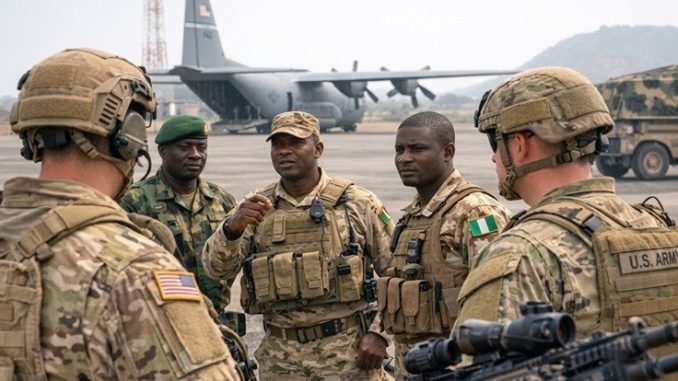
The United States is planning to remove its counterterrorism teams from Nigeria, despite ongoing violence against Christians. Photo courtesy of NTA.
Reported by:

Cherry Meigh Timbol
News Content Editor
Published September 4, 2026
The United States will begin withdrawing approximately 200 troops from northeastern Nigeria, bringing to a close a limited counterterrorism deployment launched earlier this year. Nigerian military officials insist the move marks the completion of a mission—not a breakdown in security ties between Abuja and Washington.
The troops were deployed in February 2026 under a bilateral agreement aimed at strengthening Nigeria’s fight against Islamist terrorist groups, particularly Boko Haram and the Islamic State West Africa Province (ISWAP). Their primary roles included intelligence sharing, military training, logistics support, and strategic coordination with Nigerian forces.
Why are U.S. troops leaving?
According to Nigeria’s Defence Headquarters (DHQ), the deployment was mission-specific from the beginning and tied to defined operational objectives. Military spokesman Major General Samaila Uba said the withdrawal should be viewed as a routine adjustment rather than an end to the broader U.S.–Nigeria security partnership.
Although officials initially emphasized that American personnel would not engage in direct combat, U.S. forces later participated alongside Nigerian troops in a joint operation that eliminated a senior ISWAP commander in the country’s northeast. That operation was considered one of the mission’s most significant tactical successes.
Security crisis remains unresolved
Despite the military cooperation, Nigeria continues to face one of Africa’s most complex security emergencies. Jihadist insurgencies, mass kidnappings, armed banditry, and attacks on rural communities continue across multiple regions, with analysts warning that violence has expanded beyond its traditional northern strongholds.
Recent abductions of dozens of civilians in central Nigeria have reinforced concerns that the underlying security crisis remains far from resolved, even after months of enhanced international cooperation.
🧩 Bottom Line:
The withdrawal of 200 U.S. troops is not a U.S. exit from Nigeria—it is the conclusion of a narrowly defined military mission. The deeper question is whether intelligence partnerships alone can help Nigeria reverse a security crisis that continues to evolve. For both Abuja and Washington, the next phase shifts from boots on the ground to long-term strategic cooperation against terrorism.