Reported by:

Cherry Meigh Timbol
News Content Editor
Published October 28, 2026
Israeli prime minister calls for a strong national government after a closely contested election, arguing that Israel and the United States have an opportunity to address what he describes as an existential threat from Iran.
Israeli Prime Minister Benjamin Netanyahu has called for the formation of a strong, national right-wing government after Israel’s October 27, 2026, parliamentary election, claiming that his political bloc has a “clear, decisive majority” among Jewish and Zionist voters.
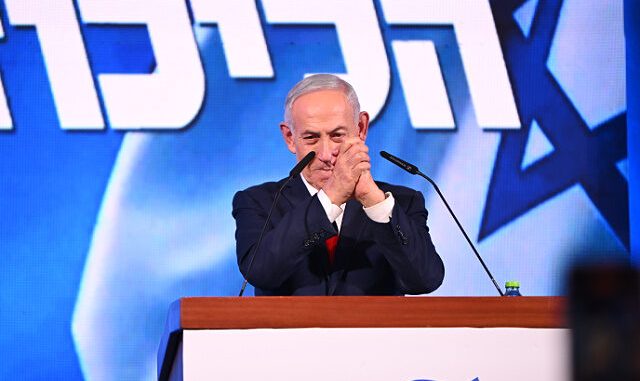
Speaking to supporters at Likud party headquarters in Jerusalem early Wednesday, October 28, Netanyahu said his Likud party had emerged as the largest single party. He argued that the right-wing bloc should form the next government and rejected the prospect of an administration dependent on Arab political parties that he considers anti-Zionist.
However, preliminary exit polls showed a closely divided political landscape, with neither Netanyahu’s bloc nor the opposition clearly reaching the 61 seats required for a majority in Israel’s 120-member Knesset. Final results were still pending following his speech.
Netanyahu Sees Opportunity to Counter Iran
A central theme of Netanyahu’s address was the continuing confrontation with Iran. He said Israeli military operations had significantly weakened the Iranian regime and altered the regional balance of power.
“ Iran is weaker than ever, Israel is stronger than ever,” Netanyahu declared, according to his published speech.
Despite describing Israel’s recent military achievements as significant, he warned that the threat had not ended while Iran’s current leadership remained in power. He argued that Tehran could continue pursuing policies hostile to Israel.
Netanyahu also pointed to cooperation with U.S. President Donald Trump as central to his stated objective of removing the Iranian threat.
He described the moment as a “historic, once-in-a-lifetime opportunity” for Israel and the United States to address the danger. His remarks did not, by themselves, establish that either government had announced a new military operation.
Push for a National Right-Wing Government
Netanyahu maintained that the election results supported his call for a government led by right-wing and Zionist parties. He argued that Israel should not rely on Arab parties that he accused of opposing the country’s existence and undermining its security.
His remarks highlighted a major divide in Israel’s post-election political debate: whether the next government should be built around Netanyahu’s existing political allies or whether opposition parties could assemble an alternative coalition.
Opposition figures disputed Netanyahu’s interpretation of the results. Former military chief Gadi Eisenkot called for Netanyahu to leave office, while former prime minister Naftali Bennett also claimed the incumbent government had lost public support.
The competing statements underscored the uncertainty surrounding the election and the difficulty of forming a governing coalition.
Election Results Remain Uncertain
Exit polls published by Israeli broadcasters offered differing projections for the distribution of seats in the Knesset. Although Likud was projected to be the largest individual party, the broader political blocs remained short of a clear parliamentary majority.
Israel’s electoral system requires parties to work together to establish a government capable of commanding the support of at least 61 lawmakers. Consequently, winning the largest number of individual party seats does not automatically guarantee the ability to govern.
The final outcome will depend on the official count and subsequent coalition negotiations. President Isaac Herzog is expected to consult political factions before assigning a lawmaker the task of forming a government.
Iran Remains Central to Netanyahu’s Agenda
Netanyahu’s address linked Israel’s domestic political future with its security priorities, particularly its confrontation with Iran. He argued that continued pressure on Tehran, alongside cooperation with Washington, offered an opportunity to address what he considers a long-standing threat to Israel.
However, his declaration that Iran had been weakened does not mean the confrontation has been resolved. The extent of Iran’s remaining military capabilities, the future direction of its leadership and the possibility of further escalation remain important questions for the region.
Any additional military action would depend on decisions by the governments involved and developments on the ground. Netanyahu’s speech outlined his strategic objectives but did not confirm a new offensive.
For now, Israel faces two connected challenges: determining which political coalition can form its next government and deciding how to pursue its security objectives toward Iran amid continuing regional tensions.