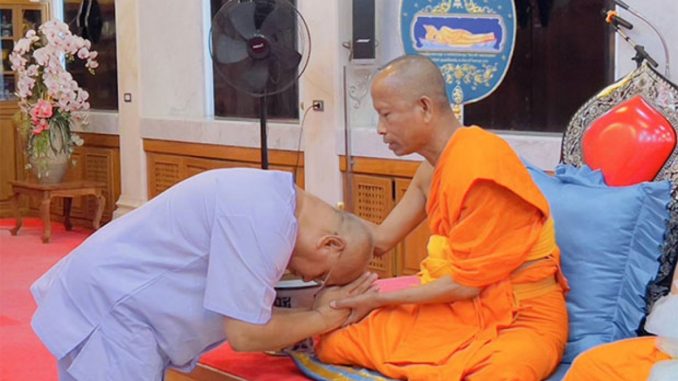
Phra Thepwatcharasitthimethi pays respect to the abbot of Wat Tak Fa in Nakhon Sawan province on July 15 last year after he left the monkhood and donned layman’s clothing. The former monk, now known by his lay name Wirach, has been sentenced to 12 years in prison for embezzling 3 million baht in donations. (File photo: Sitthipoj Kebui)
Published July 6, 2026
BANGKOK, Thailand — For generations, Thailand’s Buddhist monks have been viewed as symbols of discipline, sacrifice, and spiritual guidance. Millions of worshippers donate money to temples believing their offerings support religious education, charitable work, and the preservation of one of the country’s most sacred institutions.
But behind the peaceful image of saffron robes and temple walls, investigators uncovered a scandal that has become one of the most damaging crises ever to hit Thai Buddhism.
This week, a former senior monk was sentenced to 12 years in prison after a court found he had diverted millions of baht intended for a Buddhist university into his own account—a decision prosecutors say was driven by gambling debts and his involvement with a woman accused of operating an elaborate sextortion scheme targeting some of Thailand’s most powerful monks.
A Trusted Religious Leader Falls
The convicted former monk, once known as Phra Thepwatcharasitthimethi, served as the abbot of Wat Tha Luang Temple and held the influential position of chief monk for Thailand’s Phichit province.
For years he oversaw temple affairs and managed charitable donations entrusted by ordinary Buddhists.
According to prosecutors, that trust was betrayed when approximately 3 million baht intended for Mahachulalongkornrajavidyalaya University, one of Thailand’s leading Buddhist institutions, was secretly diverted into his personal account.
Investigators said the money did not remain there for long.
Much of it allegedly disappeared into gambling-related transactions.
The Woman at the Center of the Scandal
The investigation soon expanded far beyond a single monk.
Police identified Wilawan Emsawat, widely known in Thai media as “Sika Golf,” as the alleged architect of a sophisticated blackmail operation.
Authorities accuse her of deliberately targeting senior Buddhist monks, forming intimate relationships with them, secretly recording sexual encounters, and later demanding millions of baht to keep the recordings private.
Investigators estimate that as much as 385 million baht (about US$11.9 million) passed through the alleged operation, with much of the money reportedly lost through online gambling.
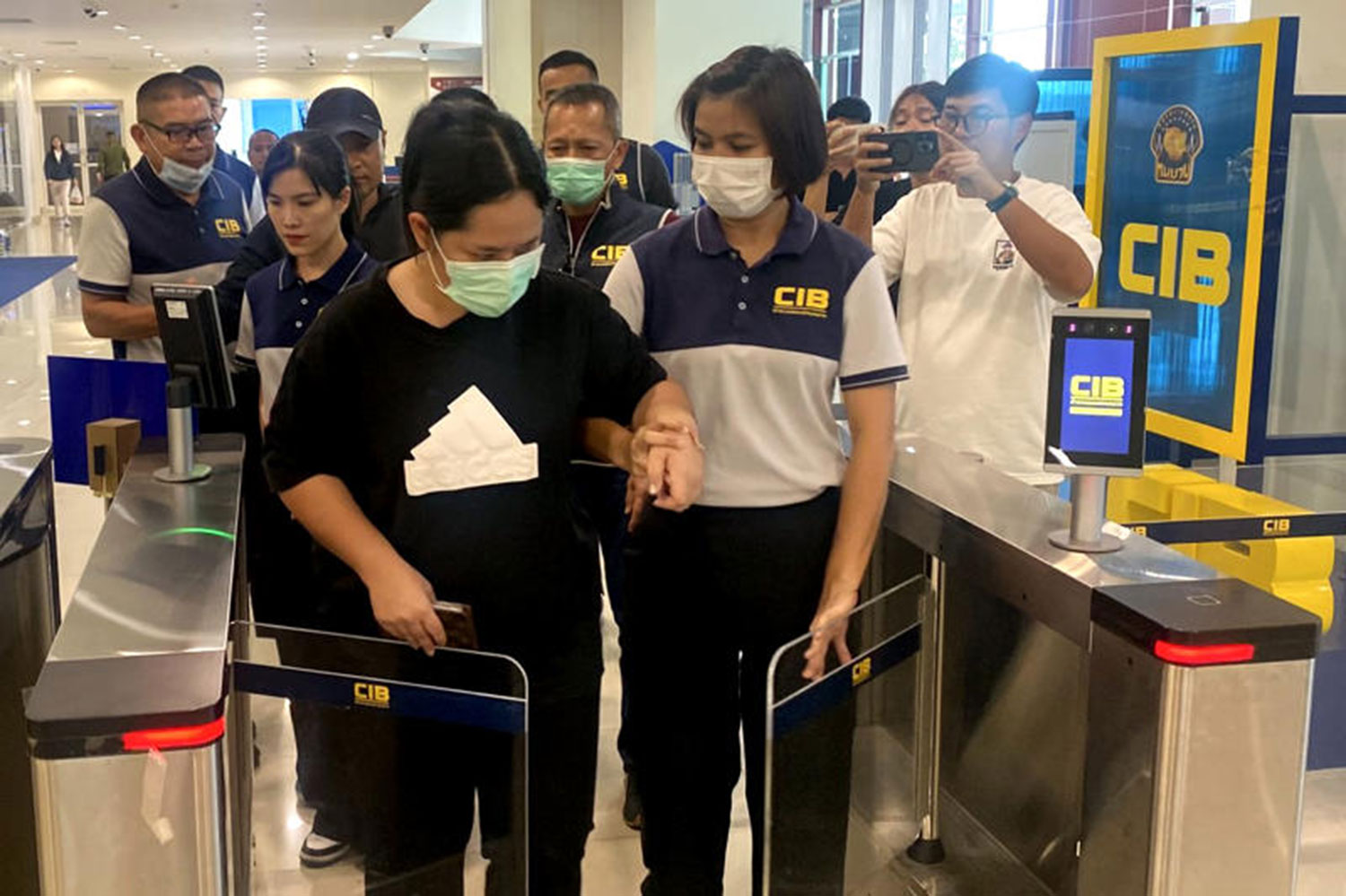 Wilawan Emsawat, better known as “Sika Golf”, 35, is taken to the Central Investigation Bureau on July 15 last year after she was arrested on various charges, including money laundering. (Photo supplied/Wassayos Ngamkham)
A Crisis for Thai Buddhism
The scandal rapidly spread through Thailand’s Buddhist hierarchy.
Multiple senior monks were defrocked after investigators connected them to the alleged blackmail network, while authorities widened financial investigations into temple accounts and charitable donations.
For many Thai citizens—where more than 90 percent of the population identifies as Buddhist—the revelations were deeply unsettling.
Temples have traditionally been regarded as among the country’s most trusted institutions.
Instead, investigators uncovered allegations of secret relationships, financial misconduct, gambling addiction, and abuse of donated funds.
The Gambling Trail
Court documents described how gambling became a central element of the corruption case.
Authorities believe the former monk’s financial decisions were heavily influenced by mounting gambling losses.
Rather than protecting money intended for religious education, prosecutors argued he redirected donations to satisfy personal financial obligations connected to online betting.
The case has renewed national debate about illegal online gambling networks operating throughout Southeast Asia and their ability to exploit vulnerable individuals—including respected religious leaders.
More Than One Conviction
While the 12-year prison sentence marks a major legal milestone, authorities say the broader investigation remains far from over.
Police continue examining additional financial transactions, alleged victims, and possible links involving other religious figures.
The scandal has become one of the largest corruption investigations involving Thailand’s Buddhist establishment in decades and has already prompted calls for sweeping institutional reforms.
Faith Tested
For millions of Buddhists, the story represents more than the downfall of a single monk.
It is a painful reminder that institutions built on trust can still be vulnerable to greed, addiction, and corruption.
As Thailand struggles to restore confidence in one of its oldest religious traditions, the case has forced uncomfortable questions about accountability, transparency, and the responsibility carried by those entrusted with both spiritual leadership and public donations.
The prison sentence may have brought one chapter to a close.
But for Thailand’s Buddhist community, rebuilding public trust could prove to be the far more difficult journey.
 Public / Political Reactions:
🇹🇭 Thai Government
Thai authorities described the case as a serious breach of public trust and vowed to strengthen oversight of Buddhist institutions.
- Government officials supported the court’s decision to sentence the former monk, emphasizing that no one is above the law.
- Authorities pledged to improve financial transparency at temples and strengthen regulations governing charitable donations.
- Law enforcement agencies indicated that investigations into related financial transactions and other individuals connected to the scandal would continue.
➡️ Position: The government says restoring public confidence in Thailand’s Buddhist institutions requires stronger oversight, transparency, and accountability.
☸️ Thailand’s Buddhist Community
Senior members of Thailand’s Buddhist establishment expressed concern that the scandal had damaged the reputation of the monkhood.
- Religious leaders called for stricter enforcement of monastic discipline and ethical standards.
- Several temples encouraged reforms aimed at improving financial accountability and preventing future misconduct.
- Many monks stressed that the actions of a few individuals should not define Thailand’s broader Buddhist community.
➡️ Position: Buddhist leaders support reforms while urging the public not to lose faith in the religion because of individual wrongdoing.
👥 Public Response
The case sparked widespread outrage across Thailand, where Buddhism plays a central role in national culture.
- Many worshippers expressed anger that temple donations intended for religious and charitable purposes were allegedly misused.
- Citizens called for greater transparency in temple finances and stricter monitoring of senior monks.
- The scandal fueled renewed debate over accountability within one of Thailand’s most respected institutions.
➡️ Position: Public confidence has been shaken, with many demanding reforms to protect the integrity of Buddhist institutions.
⚖️ Law Enforcement
Thai police described the investigation as one of the country’s most significant cases involving the Buddhist clergy.
- Investigators expanded inquiries into financial records, gambling transactions, and alleged blackmail schemes connected to multiple monks.
- Authorities announced broader efforts to investigate misconduct within the monkhood and established channels for the public to report suspected violations.
➡️ Position: Police say the investigation is intended to expose corruption, recover misused funds, and deter future misconduct.
🌍 International Observers
International media and religious scholars closely followed the scandal due to its impact on one of the world’s largest Buddhist communities.
- Analysts noted that the case has renewed discussions about governance, financial oversight, and accountability in religious institutions.
- Observers said the scandal highlights the challenges faced by faith-based organizations when trusted leaders abuse positions of authority.
➡️ Position: Experts believe the case could become a catalyst for institutional reforms while prompting broader conversations about ethics and transparency in religious organizations.
🏛️ Broader Political and Social Impact
The scandal has prompted calls for long-term reforms extending beyond the criminal case itself.
- Officials are reviewing measures to strengthen financial oversight of temples and improve governance within the Buddhist clergy.
- Religious scholars and civil society groups argue that greater transparency will be essential to restoring public trust.
- Many believe the case could become a turning point for how Thailand supervises its religious institutions in the future.
➡️ Position: The scandal is expected to accelerate reforms aimed at protecting temple finances, strengthening accountability, and rebuilding confidence in Thailand’s Buddhist establishment.
 Resulting Effects:
The conviction of the former senior Buddhist monk has sent shockwaves throughout Thailand, exposing weaknesses in financial oversight within religious institutions and triggering one of the country’s biggest crises of confidence in the Buddhist clergy. Beyond the courtroom, the scandal has sparked calls for sweeping reforms, intensified criminal investigations, and renewed public scrutiny of the management of temple donations.
1. Public Trust in the Buddhist Monkhood Has Been Shaken
The scandal has damaged the reputation of one of Thailand’s most respected institutions.
🛕 Many worshippers expressed disappointment that money donated for religious and educational purposes was allegedly misused.
🙏 Religious leaders acknowledged that the actions of a small number of monks have affected public confidence in the broader Buddhist community.
📢 Public debate has intensified over ethics, accountability, and leadership within the monkhood.
➡️ Result: Financial misconduct involving senior monks → declining public confidence and increased calls for reform.
2. Criminal Investigations Have Expanded
Authorities continue investigating individuals connected to the alleged sextortion and gambling network.
🚔 Police are examining financial records, gambling transactions, and possible links involving additional monks and associates.
💰 Investigators are attempting to trace millions of baht believed to have passed through the alleged scheme.
⚖️ Additional arrests or legal proceedings remain possible as the investigation continues.
➡️ Result: Court conviction → broader criminal investigations into corruption and financial crimes.
3. Pressure for Greater Financial Transparency
The case has renewed demands for stricter oversight of temple finances.
🏛️ Government agencies are reviewing regulations governing charitable donations and temple administration.
📊 Religious institutions may face stronger auditing requirements and improved financial reporting.
🤝 Reform advocates argue that greater transparency is necessary to restore public trust.
➡️ Result: Misuse of donated funds → increased pressure for financial accountability within Buddhist institutions.
4. National Debate on Gambling and Blackmail Networks
The investigation has also highlighted the growing influence of illegal gambling and organized blackmail operations.
🎰 Authorities say gambling debts played a significant role in the misuse of temple funds.
📱 The alleged sextortion scheme has raised concerns about how criminal networks exploit influential public figures.
🚨 Law enforcement agencies are expected to intensify efforts against online gambling and financial crime.
➡️ Result: Gambling-related corruption → renewed focus on organized crime and cyber-enabled extortion.
5. Increased Oversight of Religious Institutions
The scandal has prompted discussions about strengthening governance within Thailand’s Buddhist establishment.
☸️ Senior religious leaders are expected to review disciplinary procedures and ethical standards for monks.
🏛️ Officials are considering reforms designed to improve accountability while preserving public confidence in Buddhism.
📖 Religious scholars believe stronger institutional safeguards could help prevent similar scandals in the future.
➡️ Result: Institutional crisis → growing momentum for governance and ethical reforms.
6. International Attention on Thailand’s Religious Institutions
The case has attracted worldwide media coverage because of its impact on one of the world’s largest Buddhist communities.
🌍 International observers view the scandal as a significant test of transparency and accountability within religious organizations.
📢 The case has sparked broader discussions about financial oversight, ethical leadership, and public trust in faith-based institutions.
🤝 Analysts believe Thailand’s response may become a reference point for governance reforms in other religious organizations.
➡️ Result: High-profile scandal → increased international scrutiny and calls for stronger institutional accountability.
 Future Outlook:
The conviction of the former senior Buddhist monk is expected to have lasting consequences for Thailand’s religious institutions, legal system, and public confidence in the Buddhist clergy. As authorities continue investigating the broader sextortion and gambling network, the case is likely to drive reforms aimed at improving transparency, accountability, and ethical standards within the country’s monastic community.
1. Investigations Are Expected to Continue
Thai authorities have indicated that the case is far from over.
🚔 Police are expected to continue examining financial records, gambling transactions, and alleged links involving other monks and individuals connected to the sextortion network.
⚖️ Additional arrests, prosecutions, or disciplinary actions may follow as investigators uncover new evidence.
💰 Authorities will also seek to trace and recover funds believed to have been obtained through illegal activities.
➡️ Outlook: Ongoing investigations → potential expansion of criminal cases and legal action.
2. Reforms Within Thailand’s Buddhist Institutions
The scandal is likely to accelerate calls for changes in how temples and senior monks are supervised.
🛕 Religious authorities may introduce stricter financial controls and auditing procedures for temple donations.
📊 Greater transparency in managing charitable funds is expected to become a priority.
📖 Senior members of the Buddhist clergy are also likely to review ethical guidelines and disciplinary measures.
➡️ Outlook: Institutional reforms → stronger financial oversight and improved governance.
3. Government Oversight May Increase
The Thai government is expected to strengthen regulations governing religious institutions.
🏛️ Officials may introduce new laws or administrative measures to improve accountability within temples.
🤝 Cooperation between government agencies and religious authorities is likely to expand.
📋 Authorities are also expected to strengthen efforts against corruption involving charitable organizations.
➡️ Outlook: Enhanced regulation → greater government involvement in protecting public donations and preventing misconduct.
4. Public Trust Will Take Time to Rebuild
Although reforms may restore confidence over time, the scandal has significantly affected public perception.
🙏 Many worshippers are expected to continue supporting Buddhism while demanding higher standards from religious leaders.
👥 Temples may place greater emphasis on transparency to reassure donors and local communities.
📢 Public expectations for ethical leadership within the monkhood are likely to remain high.
➡️ Outlook: Long-term recovery → rebuilding trust through accountability and institutional reform.
5. Crackdown on Gambling and Financial Crime
Authorities are expected to intensify efforts against illegal gambling operations and organized financial crimes.
🎰 Police may expand investigations into online gambling networks linked to corruption cases.
📱 Greater attention is also likely to be given to cyber-enabled blackmail and sextortion schemes targeting influential individuals.
🚨 Law enforcement agencies are expected to strengthen cooperation in combating organized criminal activity.
➡️ Outlook: Expanded enforcement → tougher action against gambling, fraud, and financial crime.
6. A Defining Moment for Thai Buddhism
Many observers believe this scandal could become a turning point for Thailand’s Buddhist establishment.
☸️ Religious leaders have an opportunity to strengthen integrity, accountability, and public confidence within the monkhood.
🌍 The reforms introduced in response to the scandal may influence how other religious institutions address financial transparency and ethical misconduct.
📖 The long-term legacy of the case may ultimately depend on whether meaningful reforms are implemented and consistently enforced.
➡️ Outlook: Historic scandal → potential transformation of governance, ethics, and public accountability within Thailand’s Buddhist institutions.
 Bottom Line:
Some scandals disappear after the headlines fade. This is unlikely to be one of them.
For countless people across Thailand, a temple is more than a place of worship. It is where families pray for loved ones, make donations believing they are helping those in need, and place their trust in spiritual leaders who are expected to live by the very teachings they preach. That is why this case cuts so deeply.
The conviction of a former senior monk is not simply the story of stolen money or a prison sentence. It is the story of broken trust. Donations that ordinary people gave with sincere intentions were allegedly diverted for gambling, while allegations of blackmail and corruption revealed a darker reality hidden behind the image of religious devotion.
Cases like this remind us that no institution—religious, political, or otherwise—is immune from corruption when transparency and accountability are absent. The actions of one individual do not define an entire faith or the millions of honest monks and believers who continue to live according to Buddhist principles. Yet they do highlight how devastating it can be when someone entrusted with moral leadership betrays that responsibility.
As Thailand confronts the fallout from this scandal, many worshippers will continue to seek comfort in their faith while demanding higher standards from those who wear the robes. Rebuilding that confidence will take far longer than any prison sentence.
In the end, justice is measured not only by a courtroom verdict but by whether meaningful reforms follow. If this scandal leads to stronger oversight, greater transparency, and renewed integrity within Thailand’s Buddhist institutions, then perhaps something positive can emerge from one of the country’s darkest chapters. If not, the greatest loss will not be the stolen money—it will be the public trust that is far harder to restore.
SOURCES: GAMBLING NEWS – Buddhist Monk Sentenced to 12 Years for Embezzling in Gambling Scandal
THE STRAITS TIMES – Former Thai temple abbot jailed 50 years over $79m embezzlement scandal linked to online gambling
BANGKOK POST – Former chief monk given 12 years for embezzlement