Reported by:

Cherry Meigh Timbol
News Content Editor
Published October 21, 2026
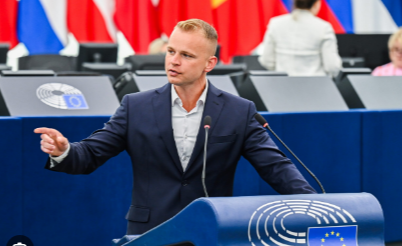
The words were direct, confrontational and unmistakably political. In a speech that drew attention across social media, Slovak member of the European Parliament Milan Mazurek turned his criticism toward progressive liberals, blaming their immigration policies for what he described as the deterioration of security and public order in Western European cities.
“Send them back! That’s for you, progressive liberals, because it was you who destroyed Western Europe,” Mazurek declared in remarks reported on October 11, 2026. He went on to argue that Slovakia and Poland had avoided similar problems because they had not adopted the same immigration policies as some Western European countries.
The speech quickly became part of a wider European debate over immigration, national identity, public safety and the future direction of the European Union.
For Mazurek, the message was a demand for a fundamental change in policy. For his critics, the language raises questions about collective blame, the treatment of migrants and the responsibilities of political leaders when discussing crime and integration.
At the heart of the controversy is a question that continues to divide Europe: how should governments balance border control and national security with human rights and the protection of people seeking a better life?
A Speech Aimed at Europe’s Political Establishment
Mazurek’s remarks were delivered during a European Parliament debate on the need for an EU strategy to address Islamist radicalisation and the influence of the Muslim Brotherhood network. A record of his parliamentary speeches identifies the debate as taking place on October 7, 2026, while his widely circulated social media video was posted on October 8.
Rather than limiting his criticism to specific laws, Mazurek directed his accusations at the politicians responsible for shaping Europe’s migration approach.
He questioned why countries such as Slovakia and Poland, in his view, had avoided the same problems he associated with migration in Western Europe. His argument was that governments should not be pressured into accepting policies that he believes have undermined security elsewhere.
The speech was therefore more than a call for deportations. It was an attack on the political assumptions behind Europe’s approach to immigration, particularly the belief that European countries should share responsibility for managing migration.
Mazurek’s position reflects a broader nationalist argument: that national governments should retain greater control over their borders and should not be compelled to follow a common migration model when they disagree with its consequences.
Why Mazurek’s Message Resonates With Immigration Critics
Immigration has remained one of the European Union’s most contentious political issues, shaped by concerns about border security, asylum procedures, integration, housing and pressure on public services.
For voters who believe their governments have lost control over migration, Mazurek’s forceful language may appear to express frustrations they feel established political parties have failed to address.
His appeal rests on a straightforward political contrast. On one side are leaders who favour more inclusive approaches to migration and European cooperation. On the other are politicians who demand stricter border enforcement, tougher deportation rules and greater national sovereignty.
However, the distinction is not absolute. Governments across the political spectrum have supported different combinations of border controls, asylum protections and returns policies.
The European Union itself has moved toward stricter migration management. Its revised migration and asylum framework, which entered into force in June 2026, includes measures intended to strengthen external borders, accelerate procedures and increase returns. The framework also contains provisions for solidarity among member states.
This development illustrates an important point: the debate is no longer simply about whether Europe should control migration. It increasingly concerns how that control should be exercised, who should bear the responsibility and what safeguards should apply.
The Controversy Over Collective Blame
The most contentious aspect of Mazurek’s speech is his sweeping portrayal of Western European cities as places overwhelmed by violent criminals and radical Islamists.
Such claims require careful scrutiny. Crime, radicalisation and integration are complex issues that cannot be adequately explained by migration status or religious identity alone. Establishing whether immigration policies have caused particular security problems requires reliable evidence, comparisons between countries and consideration of other contributing factors.
The distinction matters because migrants are not a single, uniform population. They include refugees fleeing persecution, workers, students, family members and people with different legal statuses and personal circumstances.
Critics of hard-line deportation rhetoric argue that broad accusations can stigmatise entire communities, including people who have committed no offence. Supporters of stricter immigration enforcement counter that governments must be able to discuss public safety and remove people who have no legal right to remain, subject to applicable laws and protections.
These competing concerns lie at the centre of Europe’s immigration debate: how to enforce the law effectively without treating entire communities as collectively responsible for individual crimes.
From Political Rhetoric to European Policy
Mazurek’s speech also reflects a wider transformation in European politics, where migration has become a defining issue for nationalist and right-wing parties.
His argument draws a sharp distinction between the political choices of Central and Eastern Europe and those of Western Europe. By presenting Slovakia and Poland as alternatives to the Western European model, he sought to challenge the assumption that a shared European migration policy should apply uniformly across countries with different political preferences and experiences.
Yet comparing national outcomes requires more than political declarations. Differences in migration levels, population composition, geography, labour markets, policing and historical circumstances can all affect the results. Official European statistics provide a basis for examining these differences, but they do not automatically establish the causal claims made in political speeches.
The broader question is whether a common European approach can accommodate national differences while maintaining consistent standards for asylum, border management and human rights.
For Mazurek and politicians who share his position, greater freedom to enforce restrictive national policies is central to that debate. For their opponents, European cooperation and legal safeguards remain essential to ensuring that migration enforcement does not undermine fundamental rights.
A Debate That Extends Beyond One Speech
Mazurek’s “send them back” statement has become a pointed expression of the confrontation between competing visions of Europe.
One vision places greater emphasis on national sovereignty, restrictive immigration policies and the removal of people who lack legal grounds to remain. Another stresses coordinated European solutions, protection for asylum seekers and the danger of generalising about migrants as a group.
Neither side can resolve the underlying questions through slogans alone. Governments must demonstrate whether their policies improve public safety, operate effectively and comply with the law. Political leaders must also distinguish legitimate criticism of immigration systems from claims that unfairly attribute criminality to entire populations.
Ultimately, the significance of Mazurek’s speech lies not only in its provocative wording but in the questions it brings into focus: Who should decide Europe’s migration policy? How much authority should national governments retain? And how can countries protect their citizens while respecting the rights of people within their borders?
Those questions will continue to shape European politics long after the speech itself has faded from the headlines.