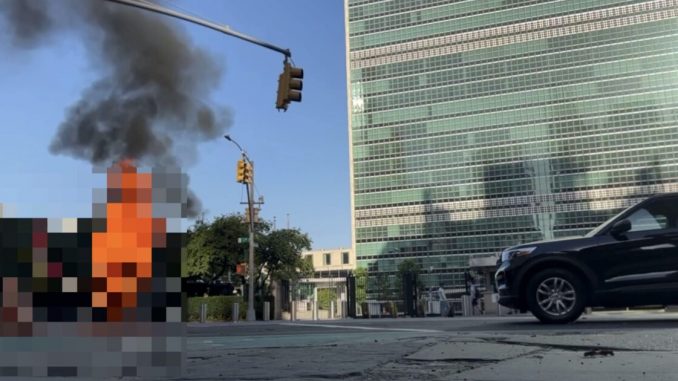
NYPD officers respond outside United Nations headquarters in Manhattan after a protester set himself on fire while displaying a Tibetan flag
Published July 3, 2026
A Tibetan activist died after setting himself on fire outside the United Nations headquarters in Manhattan on Thursday evening in what authorities and activists described as a political protest against China’s rule over Tibet.
According to the New York Police Department, officers responded to a 911 call at around 6:30 p.m. near East 43rd Street and First Avenue, where they found a man suffering from severe burns. He was rushed to Bellevue Hospital but later succumbed to his injuries. Police said the incident remains under investigation.
The protester was identified by Tibetan activists and members of the local Tibetan community as Lobga Rangzen, a 42-year-old Tibetan who had lived in the United States for about two decades and reportedly worked as an Uber driver. Friends described him as a longtime supporter of Tibetan independence and the Free Tibet movement.
Witnesses and video footage circulating online showed Rangzen carrying a Tibetan flag before placing it on the sidewalk outside the UN complex. He also reportedly scattered pamphlets, including one bearing the message “China Out of Tibet,” before setting himself on fire. The incident was livestreamed and unfolded during the evening rush hour.
The United Nations confirmed that the incident occurred after scheduled meetings had concluded and said no official UN activities were disrupted.
Tibetan advocacy groups said Rangzen’s act was intended to draw international attention to what they describe as China’s repression of Tibetans, including restrictions on religious freedom, cultural identity, and political expression. Activists also linked the protest to Beijing’s recently enacted ethnic unity law, which critics argue could further erode the rights of ethnic minorities such as Tibetans and Uyghurs.
China maintains that Tibet has been an integral part of its territory for centuries and has defended its policies in the region as promoting stability and economic development. Many Tibetans in exile, however, continue to call for greater autonomy or independence and the preservation of their cultural and religious traditions.
Self-immolation has become one of the most extreme forms of protest associated with the Tibetan independence movement. Advocacy organizations say more than 150 Tibetans have carried out similar acts since 2009 to protest Chinese rule.
Authorities have not announced any criminal investigation beyond determining the circumstances surrounding the incident.
If you or someone you know is experiencing thoughts of self-harm or suicide, help is available through local crisis services or emergency responders. If you are in immediate danger, contact your local emergency services right away.
JUST NOW: A protestor has suddenly SET HIMSELF ON FIRE outside the United Nations building in New York as some form of “protest”
Utter MADNESS. Pure psycho move.pic.twitter.com/JBFoVS0E8x
— Eric Daugherty (@EricLDaugh) July 3, 2026
 Public / Political Reactions:
🇺🇳 United Nations
The self-immolation occurred outside the United Nations headquarters in New York, drawing attention to the global body’s role in addressing human rights concerns.
- UN officials confirmed the incident took place outside the headquarters and said security personnel responded immediately alongside New York emergency services.
- The organization said the incident did not disrupt scheduled UN activities.
- As of now, the UN has not issued a formal statement on the protester’s political demands regarding Tibet.
➡️ Position: The United Nations has acknowledged the incident but has not commented on the protester’s message or broader issues concerning Tibet.
🇨🇳 Chinese Government
Beijing has consistently rejected allegations of repression in Tibet.
- Chinese authorities maintain that Tibet is an inseparable part of China and that government policies have improved economic development, education, and living standards in the region.
- China routinely dismisses accusations of human rights abuses as interference in its internal affairs.
- At the time of reporting, Chinese officials had not publicly commented on the New York incident.
➡️ Position: China continues to defend its governance of Tibet and rejects criticism from foreign governments and activist groups.
🏔️ Tibetan Government-in-Exile and Advocacy Groups
Tibetan organizations described the protest as a desperate appeal for international attention.
- Advocacy groups identified the protester as a longtime supporter of Tibetan freedom and cultural preservation.
- They said his actions reflected frustration over what they describe as decades of political repression, restrictions on religious freedom, and efforts to assimilate Tibetan culture.
- Activists renewed calls for the international community and the United Nations to address human rights concerns in Tibet.
➡️ Position: Tibetan advocacy groups view the self-immolation as a political protest intended to highlight ongoing concerns over China’s policies in Tibet.
🇺🇸 New York Authorities
Local authorities focused on the emergency response and investigation.
- The New York Police Department responded to reports of a person on fire outside the UN headquarters.
- Officers and emergency personnel extinguished the flames and transported the man to Bellevue Hospital, where he later died from his injuries.
- Police have not indicated any evidence that others were involved and continue to investigate the circumstances surrounding the incident.
➡️ Position: Authorities are treating the case as an active investigation while determining the full circumstances surrounding the protest.
🌍 Human Rights Organizations
Human rights advocates said the incident underscores continuing concerns about Tibet.
- Several organizations expressed sorrow over the protester’s death while emphasizing that self-immolation reflects profound desperation rather than a solution.
- Rights groups reiterated calls for greater international scrutiny of alleged restrictions on religious freedom, cultural identity, and civil liberties in Tibet.
- They urged governments to pursue peaceful diplomatic efforts to address human rights concerns.
➡️ Position: Human rights organizations mourned the death while renewing calls for international attention to conditions in Tibet through peaceful means.
👥 Public Response
The incident prompted strong reactions both online and within Tibetan communities.
- Supporters of the Tibetan cause described the protest as a tragic sacrifice intended to draw global attention to Tibet.
- Others expressed concern over the use of self-immolation as a form of political protest, emphasizing the devastating human cost.
- The event reignited debate on social media over China’s policies in Tibet and the effectiveness of dramatic acts of protest.
➡️ Position: Public reaction has been mixed, with many expressing sympathy for the protester’s cause while mourning the loss of life and discouraging self-harm.
🌐 Broader Political Debate
The incident has renewed international discussion about Tibet and human rights.
Analysts say the protest has once again placed Tibet in the global spotlight during a period of heightened scrutiny over China’s human rights record.
Some observers argue that such demonstrations reflect frustration over limited international action on Tibet.
Others caution that while the protest has drawn attention, meaningful progress will likely depend on sustained diplomatic engagement rather than acts of self-sacrifice.
➡️ Position: The tragedy has revived debate over Tibet, human rights advocacy, and the international community’s response to longstanding political grievances.
 Resulting Effects:
The self-immolation of a Tibetan protester outside the United Nations headquarters in New York has renewed international attention on Tibet, human rights advocacy, and the use of extreme acts of protest to draw global awareness. The incident is expected to fuel continued discussions on China’s policies in Tibet and the international community’s response.
1. Renewed Global Attention on Tibet
The incident has placed Tibet back in the international spotlight.
🌍 The protest outside the UN headquarters drew worldwide media coverage.
🏔️ Tibetan advocacy groups used the incident to highlight concerns over religious freedom, cultural preservation, and political rights.
📢 Activists called on governments and international organizations to give greater attention to Tibet.
➡️ Result: High-profile protest → renewed international focus on Tibet and its human rights situation.
2. Increased Calls for International Action
The protest has intensified appeals for diplomatic engagement.
🇺🇳 Human rights advocates urged the United Nations and world leaders to address concerns raised by Tibetan groups.
🤝 Advocacy organizations called for peaceful international dialogue regarding Tibet.
📜 Governments may face renewed pressure to raise Tibet-related issues in diplomatic discussions with China.
➡️ Result: International attention → stronger calls for diplomatic action on Tibet.
3. Renewed Debate Over China’s Tibet Policies
The incident has reignited discussion about Beijing’s governance of Tibet.
🇨🇳 China continues to defend its policies as promoting stability and economic development.
⚖️ Critics argue that restrictions on religion, culture, and political expression remain significant concerns.
🌍 The protest has revived international debate over competing narratives surrounding Tibet.
➡️ Result: Public protest → renewed scrutiny of China’s policies in Tibet.
4. Heightened Security Around High-Profile International Sites
The self-immolation has prompted attention to security near major diplomatic institutions.
🚓 New York authorities responded quickly alongside emergency personnel.
🏢 Security officials may review existing protocols around demonstrations near the United Nations headquarters.
🛡️ Authorities continue balancing public safety with the protection of peaceful protest rights.
➡️ Result: High-profile incident → increased review of security measures at international venues.
5. Broader Discussion on Extreme Forms of Protest
The tragedy has renewed debate about self-immolation as a form of political expression.
💬 Many observers described the act as reflecting profound desperation.
🕊️ Human rights groups emphasized that meaningful change should be pursued through peaceful advocacy rather than self-harm.
📚 The incident has sparked renewed discussion about the historical use of self-immolation in political movements.
➡️ Result: Self-immolation → broader discussion on political protest and nonviolent advocacy.
6. Continued International Human Rights Debate
The incident is expected to keep Tibet within broader human rights discussions.
🌐 Advocacy organizations continue urging greater international monitoring of conditions in Tibet.
⚖️ The protest has reinforced calls for continued dialogue on religious freedom, cultural identity, and civil liberties.
📢 Analysts expect the incident to remain part of wider discussions on global human rights and international diplomacy.
➡️ Result: Tragic protest → continued international debate over human rights, Tibet, and diplomatic engagement.
 Future Outlook:
The death of a Tibetan protester who set himself on fire outside the United Nations headquarters in New York is expected to remain part of the broader international discussion on Tibet, human rights, and political activism. The incident may continue to influence diplomatic conversations, advocacy efforts, and security planning around major international institutions.
1. Investigation Into the Incident Will Continue
Authorities are expected to complete their investigation into the circumstances surrounding the protest.
🚓 The New York Police Department will continue reviewing evidence and witness accounts.
📄 Officials are expected to determine the full sequence of events leading up to the self-immolation.
⚖️ Authorities have not indicated that anyone else was involved, but the investigation remains ongoing.
➡️ Outlook: Ongoing investigation → official findings on the circumstances of the incident.
2. Tibet Is Likely to Receive Renewed International Attention
The protest may keep Tibet in international human rights discussions.
🌍 Advocacy groups are expected to continue highlighting concerns over religious freedom, cultural preservation, and political rights.
📢 International organizations may face renewed calls to address issues raised by Tibetan activists.
🤝 Diplomatic discussions involving China may again include Tibet-related human rights concerns.
➡️ Outlook: Global attention → continued international discussion on Tibet and human rights.
3. Security Around Major International Sites May Be Reviewed
Authorities may reassess security procedures near high-profile diplomatic locations.
🏢 Security officials could evaluate protest-response protocols around the United Nations headquarters.
🚨 Emergency preparedness measures may be reviewed following the incident.
🛡️ Officials are expected to continue balancing public safety with the protection of peaceful demonstrations.
➡️ Outlook: High-profile incident → possible enhancements to security and emergency response planning.
4. Human Rights Advocacy Is Expected to Continue
Advocacy organizations are likely to maintain campaigns focused on Tibet.
📚 Human rights groups are expected to continue documenting alleged abuses and promoting international awareness.
🕊️ Many organizations are likely to encourage peaceful advocacy rather than acts of self-harm.
🌐 Campaigns may continue urging governments to raise Tibet during international forums.
➡️ Outlook: Continued advocacy → sustained international attention to Tibet through peaceful engagement.
5. Debate Over China’s Tibet Policies Will Persist
The incident is expected to remain part of ongoing discussions about China’s governance of Tibet.
🇨🇳 China is likely to continue defending its policies as promoting stability and development.
⚖️ Critics are expected to continue raising concerns over religious freedom, cultural identity, and civil liberties.
🌍 International observers will likely monitor future developments in the region.
➡️ Outlook: Continuing international attention → ongoing debate over China’s policies in Tibet.
6. Global Discussion on Political Protest May Continue
The tragedy may influence future conversations about extreme forms of political protest.
💬 Analysts and advocacy groups are expected to continue discussing the motivations behind self-immolation as a form of protest.
🕊️ Mental health professionals and human rights advocates are likely to emphasize nonviolent methods of expressing political grievances.
🌍 The incident may remain a reference point in future discussions about political activism, human rights, and freedom of expression.
➡️ Outlook: Lasting international attention → continued debate over political protest, human rights advocacy, and peaceful civic engagement.
 Bottom Line:
Watching someone reach a point where they believe setting themselves on fire is the only way the world will pay attention is heartbreaking. Regardless of where people stand on the political issues surrounding Tibet and China, the loss of a human life is a tragedy that should never be celebrated or romanticized. If anything, this incident is a reminder that unresolved conflicts and human rights disputes can leave people feeling so desperate that they resort to irreversible acts.
The protest has once again brought Tibet into the global conversation, but it also raises a difficult question: How many more lives must be lost before the international community finds more effective, peaceful ways to address longstanding grievances? Ultimately, lasting change is more likely to come through dialogue, diplomacy, and sustained advocacy—not through acts that end a life.
SOURCES: THE GATEWAY PUNDIT – Protester Sets Himself on Fire Outside UN Headquarters in New York City
THE NEW YORK POST – Protester with Tibetan flag fatally sets himself on fire outside UN headquarters in NYC: sources