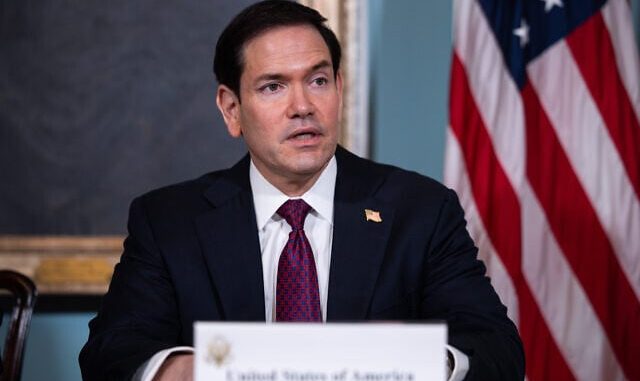
US Secretary of State Marco Rubio speaks alongside Paraguay’s Vice President Pedro Alliana (not pictured), in the Treaty Room at the US State Department, August 4, 2026, in Washington. (AP Photo/Tierney L. Cross)
Reported by:

Cherry Meigh Timbol
News Content Editor
Published August 5 , 2026
The United States and Iran appear to be moving closer to a potential agreement to reopen the Strait of Hormuz, as diplomatic efforts intensify following a warning from U.S. President Donald Trump. Officials say progress has accelerated in recent days, raising the possibility of a deal being reached within a very short timeframe.
U.S. Secretary of State Marco Rubio stated that meaningful progress has been made in negotiations aimed at restoring safe passage through the vital waterway, though he emphasized that additional work remains before a final agreement can be secured. Treasury Secretary Scott Bessent echoed this optimism, suggesting that a deal could potentially be finalized as early as the next day.
The Strait of Hormuz is one of the world’s most critical oil shipping routes, and any disruption has significant implications for global energy markets and international trade.
Diplomatic Push to Reopen Hormuz
Negotiations have intensified as both sides seek to prevent further economic and geopolitical fallout.
Key developments in the talks include:
- Accelerated diplomatic engagement between U.S. and Iranian officials.
- Discussions focused on ensuring safe maritime passage for oil tankers.
- Signals from U.S. officials that sanctions-related considerations may be part of broader negotiations.
- Indications that a framework agreement could be reached quickly if remaining issues are resolved.
Officials involved in the talks describe the current phase as critical, with both sides working under pressure to avoid further escalation.
Trump Warning Spurs Urgency
The renewed momentum in negotiations follows a strong warning from President Trump, which appears to have pushed discussions forward.
U.S. officials indicated that the warning underscored the importance of reopening the strait and preventing further disruption to global oil flows. The statement added urgency to ongoing diplomatic efforts, prompting faster movement in what had previously been slower negotiations.
Analysts say the administration is attempting to balance pressure with diplomacy, using strong rhetoric while keeping negotiation channels open.
Remaining Challenges in Talks
Despite progress, officials caution that unresolved issues still stand in the way of a final agreement.
Rubio noted that while discussions have been productive, “there’s still some work to do,” pointing to lingering disagreements that must be addressed before any deal can be finalized.
Potential sticking points include:
- Security guarantees for shipping routes.
- Conditions tied to sanctions relief or enforcement.
- Verification mechanisms to ensure compliance by all parties.
Diplomats remain cautiously optimistic but stress that last-minute complications could still delay an agreement.
Global Economic and Security Impact
The outcome of the Hormuz negotiations carries major implications for global markets and regional stability.
The strait handles a significant portion of the world’s oil supply, making it a strategic chokepoint. Any disruption can lead to spikes in oil prices, supply chain uncertainty, and broader economic consequences.
Reopening the passage would likely stabilize energy markets and reduce tensions in the region, while failure to reach an agreement could heighten risks of confrontation.
👥 Public / Political Reactions:
🇺🇸 United States Officials
U.S. officials have expressed cautious optimism as negotiations to reopen the Strait of Hormuz continue to advance.
- Secretary of State Marco Rubio emphasized that progress has been made but noted that key issues still need to be resolved.
- Treasury Secretary Scott Bessent suggested a deal could be reached quickly, signaling confidence in the current pace of negotiations.
- Officials highlighted the importance of restoring stability to global energy markets and ensuring secure maritime routes.
➡️ Position: U.S. leaders support a diplomatic resolution but stress that any agreement must protect international shipping and national security interests.
🇮🇷 Iranian Government
Iranian officials have signaled openness to continued negotiations while maintaining firm positions on sovereignty and sanctions.
- Tehran has pushed for guarantees related to sanctions relief as part of any broader agreement.
- Iranian leaders have emphasized their role in securing the region while rejecting external pressure.
- Officials have called for mutual respect in negotiations and warned against unilateral actions.
➡️ Position: Iran supports reopening the strait under conditions that respect its economic and political interests.
🏛️ U.S. Political Leaders
Reactions among American political figures have reflected both support and caution regarding the negotiations.
- Some lawmakers welcomed progress, citing the importance of stabilizing global oil flows.
- Others warned against making concessions that could weaken U.S. leverage or security commitments.
- Several officials called for transparency in the terms of any potential agreement.
➡️ Position: U.S. political leaders broadly support diplomacy but remain divided over how far negotiations should go.
🌍 International Community
Global leaders and allied nations are closely monitoring developments in the Hormuz talks.
- Energy-dependent countries have expressed hope for a swift resolution to avoid market disruptions.
- European and Asian allies have encouraged continued diplomatic engagement.
- International observers stress the importance of maintaining freedom of navigation in the region.
➡️ Position: The international community favors a quick and peaceful resolution to ensure economic stability and secure trade routes.
🛢️ Energy and Economic Analysts
Experts in global energy markets have highlighted the high stakes tied to the outcome of the negotiations.
- Analysts note that even minor disruptions in the strait can significantly impact oil prices.
- Some experts believe a deal could quickly stabilize markets and reduce volatility.
- Others caution that long-term stability will depend on sustained diplomatic engagement beyond a short-term agreement.
➡️ Position: Analysts support reopening the strait but emphasize the need for durable, long-term solutions.
👥 Public Response
Public reaction has been mixed, reflecting broader geopolitical concerns.
- Some view the negotiations as a necessary step to prevent economic disruption and conflict.
- Others remain skeptical, questioning whether any agreement will hold over time.
- Social media discussions have focused on energy prices, global security, and trust between negotiating parties.
➡️ Position: Public opinion is divided, balancing hopes for stability with concerns over long-term reliability.
🏛️ Broader Political Impact
The Hormuz negotiations are expected to influence wider geopolitical dynamics.
- The talks may shape future U.S.-Iran relations and broader Middle East diplomacy.
- Lawmakers could increase oversight of agreements involving sanctions and security guarantees.
- The situation may remain a key issue in global economic and security discussions.
➡️ Position: The negotiations highlight the intersection of energy security, diplomacy, and geopolitical strategy, with lasting political implications.
⚠️ Resulting Effects:
The accelerating negotiations to reopen the Strait of Hormuz following U.S. pressure and diplomatic engagement have triggered significant geopolitical, economic, and security implications. While a final agreement has not yet been confirmed, the progress itself is already shaping global expectations and strategic calculations.
1. Global Oil Markets Show Signs of Stabilization
Progress in talks has eased immediate fears of prolonged disruption in energy supplies. 🛢️ Oil prices have shown reduced volatility amid optimism over a possible deal.
📉 Traders are reacting to signals that supply routes may soon normalize.
🌍 Energy-importing nations are closely monitoring developments to adjust forecasts.
➡️ Result: Diplomatic progress → short-term stabilization in global oil markets.
2. Diplomatic Momentum Between U.S. and Iran Has Increased
The talks have reopened a channel for direct or indirect engagement between Washington and Tehran. 🤝 Renewed negotiations suggest both sides are willing to pursue dialogue under pressure.
📞 Diplomatic communication has intensified after a period of heightened tension.
⚖️ The situation reflects a balance between pressure tactics and negotiation efforts.
➡️ Result: Renewed talks → increased diplomatic engagement between adversaries.
3. Strategic Importance of the Strait of Hormuz Reaffirmed
The crisis has once again highlighted the global dependence on the vital shipping route. 🚢 A significant portion of the world’s oil supply passes through the strait.
🌐 Disruptions have underscored vulnerabilities in global trade infrastructure.
🛡️ Countries are reassessing strategies to secure critical maritime chokepoints.
➡️ Result: Tensions in Hormuz → renewed focus on strategic maritime security.
4. Pressure on Sanctions and Economic Policy Has Intensified
Negotiations have brought attention to the role of sanctions in U.S.-Iran relations. 💰 Discussions may involve potential adjustments to sanctions enforcement or relief.
📊 Economic considerations are central to both sides’ negotiation strategies.
⚠️ Policymakers face challenges balancing economic leverage with diplomatic goals.
➡️ Result: Ongoing negotiations → increased scrutiny of sanctions policy.
5. Regional Security Calculations Are Shifting
Middle Eastern countries are closely watching the talks and adjusting their positions. 🌍 Regional powers are reassessing alliances and security strategies.
🛡️ Military readiness remains a concern amid uncertainty over final outcomes.
📡 Neighboring states are monitoring potential spillover effects of any agreement.
➡️ Result: Diplomatic developments → shifting regional security dynamics.
6. Market and Business Confidence Is Being Tested
Businesses dependent on stable shipping routes are reacting to the evolving situation. 📦 Shipping and logistics companies are preparing for possible reopening scenarios.
📈 Investor sentiment has improved but remains cautious pending confirmation of a deal.
⚓ Energy and trade sectors are particularly sensitive to sudden changes.
➡️ Result: Negotiation progress → cautious optimism in global markets.
7. Risk of Sudden Escalation Still Remains
Despite progress, the situation remains fragile and subject to rapid change. ⚠️ Unresolved issues could delay or derail a final agreement.
💥 Any breakdown in talks may trigger renewed tensions or conflict.
📊 Markets and governments remain alert to unexpected developments.
➡️ Result: Incomplete agreement → continued risk of geopolitical escalation.
🔮 Future Outlook:
The ongoing negotiations to reopen the Strait of Hormuz are expected to remain a critical focus in global diplomacy, energy security, and geopolitical strategy. While recent progress has raised optimism about a possible agreement, uncertainties surrounding final terms and long-term stability mean the situation will likely continue evolving in the coming weeks and months.
1. Negotiations Could Reach a Breakthrough — or Stall
Talks between the United States and Iran are approaching a decisive stage.
🤝 Officials have indicated a deal could be reached quickly if remaining issues are resolved.
⚠️ However, unresolved disagreements could delay or derail progress.
📊 Last-minute complications are common in high-stakes negotiations.
➡️ Outlook: Ongoing talks → potential for rapid breakthrough or sudden delay.
2. Global Energy Markets Will Remain Highly Sensitive
Energy markets are expected to react quickly to any developments in the negotiations.
🛢️ A confirmed deal could stabilize oil prices and restore market confidence.
📉 Any disruption or failure in talks may trigger renewed price volatility.
🌍 Energy-importing nations will continue monitoring supply risks closely.
➡️ Outlook: Hormuz developments → continued impact on global oil market stability.
3. U.S.-Iran Relations May Enter a New Phase
The negotiations could influence broader diplomatic relations between Washington and Tehran.
🇺🇸 The U.S. may balance pressure with continued diplomatic engagement.
🇮🇷 Iran is likely to push for economic concessions tied to sanctions.
📞 Future dialogue may depend on the success and enforcement of any agreement.
➡️ Outlook: Current talks → possible shift toward cautious diplomatic engagement.
4. Regional Security Will Remain a Key Concern
Even with a potential agreement, security risks in the region are unlikely to disappear.
🛡️ Military readiness among regional powers is expected to remain high.
🌍 Neighboring countries will continue adjusting their defense strategies.
⚓ Maritime security operations may remain active to protect shipping routes.
➡️ Outlook: Ongoing tensions → sustained focus on regional security measures.
5. Long-Term Stability Will Depend on Enforcement
Any agreement reached will require strong mechanisms to ensure compliance.
📋 Verification systems may be necessary to monitor adherence by all parties.
⚖️ Disputes over implementation could arise after an agreement is signed.
🔍 Continued diplomatic oversight will likely be required.
➡️ Outlook: Agreement terms → long-term stability dependent on enforcement.
6. Political Debate in the U.S. Is Likely to Continue
Domestic political reactions are expected to shape how any deal is received.
🏛️ Lawmakers may debate the balance between diplomacy and national security.
📣 Critics could question concessions made during negotiations.
🗳️ The issue may become part of broader political discourse.
➡️ Outlook: Policy decisions → continued political debate and scrutiny.
7. Strategic Importance of Hormuz Will Stay in Focus
The situation will reinforce the long-term importance of securing global trade routes.
🚢 Governments may invest more in protecting maritime chokepoints.
🌐 International cooperation could increase to safeguard shipping lanes.
📡 The strait will remain a key geopolitical flashpoint.
➡️ Outlook: Continued reliance on Hormuz → sustained global strategic attention.
🧩 Bottom Line:
The accelerating negotiations to reopen the Strait of Hormuz have underscored the high stakes of global energy security, geopolitical stability, and U.S.-Iran relations. While recent progress has raised hopes for a near-term agreement, key issues remain unresolved, leaving the outcome uncertain as diplomatic efforts continue under intense international scrutiny.
🏛️ For U.S. policymakers, the talks highlight the challenge of balancing diplomatic engagement with pressure tactics, particularly in ensuring that any agreement protects national security interests while stabilizing global markets.
🇮🇷 For Iran, the negotiations represent an opportunity to secure economic relief and assert its role in regional security, while maintaining its موقف on sovereignty and sanctions.
🌍 For the international community, the situation emphasizes the importance of keeping critical shipping routes open, as disruptions in the Strait of Hormuz have immediate consequences for global trade and energy supplies.
🛢️ For global markets, progress toward reopening the strait has provided cautious optimism, but uncertainty remains as investors and industries await confirmation of a lasting agreement.
➡️ Bottom Line: The outcome of the Hormuz negotiations will play a crucial role in shaping short-term market stability and long-term geopolitical dynamics. Whether a deal is reached quickly or delayed by unresolved issues, the situation will remain a key focal point in global diplomacy, energy security, and regional stability.
SOURCES: BREITBART NEWS – Rubio: Hormuz Talks Accelerate After Trump Warning — Treasury Secretary Bessent Says Deal Possible by ‘Tomorrow’
THE TIMES OF ISRAEL – Trump says ‘all-day’ talks held with Iran, deal could happen on Wednesday or Thursday