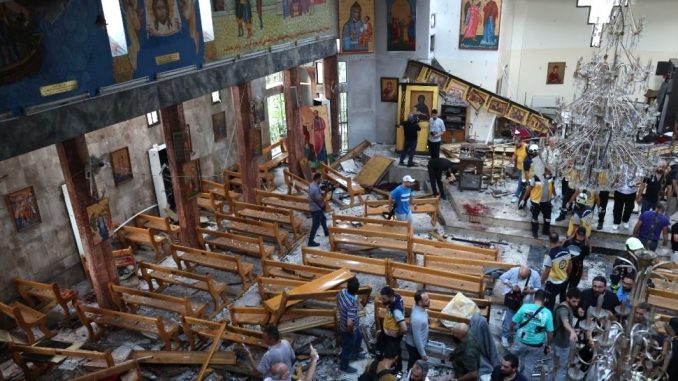
Since the 2025 attack on Mar Elias Church, Christians in Syria have been repeatedly targeted by Islamist groups. Photo: Ali Haj Suleiman / UNOCHA, CC BY 4.0 https://creativecommons.org/licenses/by/4.0, via Wikimedia Commons.
Published April 5, 2026
Syria’s embattled Christian minority is once again facing rising violence, deepening fears that religious persecution is far from over despite the country’s political transition.
Recent reports highlight a troubling pattern: attacks, intimidation, and instability continue to plague Christian communities across the war-torn nation. The latest incidents underscore what many observers warn is a worsening security environment following the fall of longtime leader Bashar al-Assad in late 2024.
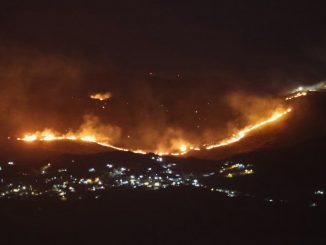
In one recent outbreak, a dispute between individuals escalated into broader sectarian violence in a predominantly Christian town, leaving homes, businesses, and vehicles damaged after armed groups carried out coordinated attacks.
While Syrian authorities have publicly condemned such violence, critics argue the government has struggled—or failed—to fully rein in militant factions operating across the country.
A Vulnerable Minority in a Fragile State
Christians, who once made up roughly 10% of Syria’s population, have seen their numbers dwindle dramatically after more than a decade of war, displacement, and targeted attacks.
Today, only a fraction remain, with many fleeing due to safety concerns and economic collapse.
Human rights groups and watchdog organizations report that violence against Christians has surged sharply in recent months. Syria has even re-entered the list of the world’s most dangerous countries for Christians, driven largely by a spike in attacks and instability.
Experts point to a dangerous mix of weak central authority, extremist ideology, and ongoing sectarian tensions as key drivers behind the unrest.
Fear, Uncertainty, and Calls for Protection
Christians on the ground describe an atmosphere of fear and uncertainty, with some reluctant to openly practice their faith. In past incidents, churches have been targeted, and worshippers killed in bombings—further shaking confidence in the country’s ability to protect religious minorities.
Advocacy groups warn that without stronger protections, the historic Christian presence in Syria—dating back to the earliest days of Christianity—could continue to shrink.
International Concern Growing
The ongoing violence has drawn concern from international observers, with some urging global leaders not to overlook the plight of Syria’s religious minorities.
Analysts say the situation reflects a broader pattern seen in post-conflict regions: when centralized control weakens, minority communities often bear the brunt of instability.
For Syria’s Christians, the future remains uncertain—caught between lingering conflict, political transition, and the persistent threat of targeted violence.
🔍 Critical View: CHRISTIANS IN SYRIA FACE VIOLENCE AMID GLOBAL SILENCE
The continuing attacks on Christians in Syria are drawing renewed scrutiny—not only for the violence itself, but for what critics describe as a muted and inconsistent global response to religious persecution.
A PERSECUTED MINORITY, A QUIET RESPONSE
Christian communities in Syria, among the oldest in the world, are once again under threat from escalating unrest. Reports of destroyed property, intimidation, and targeted violence paint a troubling picture.
Yet, despite the severity, international outrage has remained limited. Critics argue that when Christians are the victims, the response from global institutions, media, and policymakers tends to be far less urgent or sustained.
INSTABILITY BREEDS VULNERABILITY
The fall of Bashar al-Assad created a fragile power structure, leaving large areas without consistent law enforcement. In that vacuum, armed factions and extremist elements have expanded their reach.
For Christians, this has translated into heightened insecurity, fewer protections, and growing pressure to flee or stay silent about their faith.
DOUBLE STANDARD IN HUMAN RIGHTS?
A growing number of observers point to what they see as a selective application of human rights advocacy. While some global crises prompt immediate condemnation and coordinated action, violence against Christians often appears to be framed as part of broader conflict—rather than recognized as targeted persecution.
This perceived imbalance raises concerns that religious freedom is not being defended consistently, especially when doing so may not align with prevailing political or diplomatic priorities.
THE BIGGER PICTURE
What is happening in Syria is not just about one country—it reflects a wider issue. If the international community fails to respond decisively to the persecution of religious minorities, critics warn, it risks normalizing silence in the face of targeted violence.
👥 On the Ground: CHRISTIANS IN SYRIA FACE DAILY FEAR AMID RISING VIOLENCE
In parts of Syria, life for Christian families has become a constant calculation of risk—where attending church, running a business, or even speaking openly about one’s faith can carry serious consequences.
LIVING UNDER THREAT
Residents in predominantly Christian areas describe an atmosphere of uncertainty and fear, as reports of harassment, property destruction, and sporadic attacks continue to surface.
Local accounts suggest that what may begin as isolated disputes can quickly escalate into broader violence, with armed groups stepping in and targeting entire communities. For many, security feels fragile at best—and nonexistent at worst.
AFTER THE FALL: A DANGEROUS VACUUM
Following the fall of Bashar al-Assad, the absence of strong centralized control has reshaped daily life. In some المناطق, authority is fragmented, and enforcement of law varies widely depending on who holds power.
On the ground, this has meant that minority communities often have little recourse when threatened, relying instead on local networks or simply choosing to stay quiet to avoid drawing attention.
FAITH IN THE SHADOWS
Church leaders and residents report that some Christians are now practicing their faith more discreetly. Public expressions of belief, once a normal part of community life, are increasingly approached with caution.
This shift reflects a deeper concern: that religious identity itself is becoming a liability in areas where extremist elements operate with relative freedom.
FORCED CHOICES: STAY OR LEAVE
For many families, the decision is becoming unavoidable—remain and endure growing insecurity, or leave behind homes, history, and livelihoods.
Those who stay often do so out of deep roots and commitment to their communities. But with each new incident, the pressure to leave intensifies, contributing to the steady decline of Syria’s Christian population.
🎯 The Final Word:
The situation facing Christians in Syria underscores a hard reality: when order collapses and moral clarity fades, it is often the most vulnerable who pay the highest price. The continued violence, coupled with a restrained global response, raises serious concerns about whether principles like religious freedom are being upheld consistently or selectively. As instability persists following the fall of Bashar al-Assad, the future of Syria’s Christian communities hangs in the balance—serving as a stark reminder that ignoring targeted persecution today may only allow it to deepen tomorrow.
SOURCES: THE GATEWAY PUNDIT – Violence Against Syria’s Christians Continues
LOS ANGELES TIMES – In Syria, an argument between two men in a Christian town erupts into sectarian violence