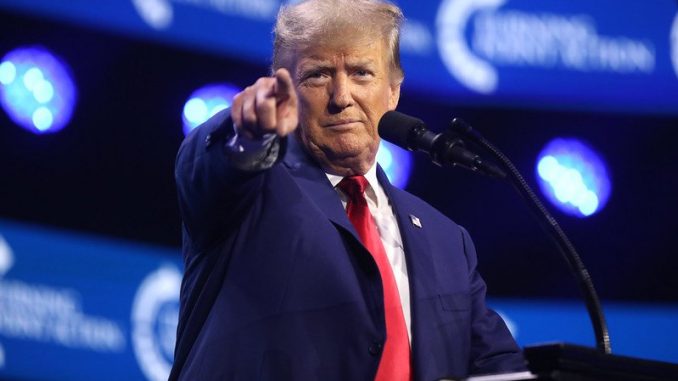
President of the United States Donald Trump speaking with attendees at the 2023 Turning Point Action Conference at the Palm Beach County Convention Center in West Palm Beach, Florida. (Credit: Gage Skidmore / Flickr)
Published April 5, 2026
Tensions in the Middle East reached a boiling point this week as Donald Trump issued a stark warning to Iran: comply within 48 hours—or face overwhelming military consequences.
The ultimatum comes as the United States ramps up pressure in an already intensifying conflict, signaling that further strikes are not only possible—but imminent if Tehran refuses to back down.
A 48-HOUR DEADLINE
In a dramatic escalation, Trump warned that Iran must reopen the strategically vital Strait of Hormuz or risk severe retaliation.
The narrow waterway carries roughly 20% of the world’s oil supply, making it one of the most critical chokepoints in global trade. Recent disruptions—linked to Iranian threats and attacks—have already triggered a sharp decline in shipping traffic and rising fears of economic fallout.
Trump’s message was blunt: failure to act would bring consequences described as “all hell” breaking loose—underscoring the urgency and seriousness of the situation.
SIGNS OF A BROADER MILITARY PUSH
The warning comes amid reports that the U.S. is considering expanded strikes targeting Iranian infrastructure, including energy and transportation systems.
Officials say the goal is to cripple Iran’s ability to sustain military operations and pressure its leadership into compliance.
At the same time, the conflict is already intensifying. U.S. and allied forces have carried out coordinated strikes, while Iran has responded with missile and drone attacks across the region—raising fears of a wider war.
 Iran has continued to fire missile attacks against Israel and US Gulf allies.
A WAR WITH GLOBAL CONSEQUENCES
The standoff is not just military—it’s economic and geopolitical.
With the Strait of Hormuz under threat, global oil markets have reacted sharply, and international shipping routes remain on edge. Analysts warn that a prolonged disruption could ripple across economies worldwide, driving up fuel prices and destabilizing already fragile markets.
Meanwhile, the situation on the ground continues to deteriorate, with thousands reported killed and critical infrastructure damaged as both sides escalate their campaigns.

Smoke rising from the Thai bulk carrier ‘Mayuree Naree’ near the Strait of Hormuz after an attack, on March 11, 2026.
A MOMENT OF DECISION
Trump’s ultimatum marks a defining moment in the conflict. Supporters argue that decisive action is necessary to deter further aggression and protect global interests. Critics, however, warn that the situation risks spiraling into a broader regional war with unpredictable consequences.
For now, the clock is ticking.
🔍 Critical View: IRAN TESTS LIMITS AS U.S. DRAWS A HARD LINE
The escalating standoff between the United States and Iran is being seen by many observers as a defining moment—not just for regional stability, but for how firmly global powers are willing to confront direct challenges to international order.
A LONG PATTERN OF PROVOCATION
For years, Iran has been accused of testing boundaries through proxy conflicts, threats to shipping lanes, and strategic posturing in key waterways like the Strait of Hormuz. Critics argue that repeated restraint by the international community has only emboldened further aggression.
The latest warnings from Donald Trump signal a shift—away from cautious responses and toward a more forceful stance aimed at reestablishing deterrence.
DETERRENCE OR DANGEROUS DELAY?
Supporters of a stronger response say that failing to act decisively in moments like this risks sending the wrong message—not just to Iran, but to other actors watching closely.
They argue that clear red lines, backed by credible consequences, are essential to preventing escalation, not causing it. In this view, measured but firm action is seen as the only way to restore stability and protect critical global interests.
GLOBAL TRADE ON THE LINE
At the center of the crisis is the free flow of commerce. The Strait of Hormuz remains one of the world’s most vital oil transit routes, and any disruption carries immediate global consequences.
From this perspective, the issue extends beyond geopolitics—it becomes a question of whether strategic choke points can be threatened without meaningful pushback.
A TEST OF RESOLVE
Critics of past approaches argue that hesitation and mixed signals have contributed to the current situation. The concern now is whether the United States will maintain a consistent posture or revert to a cycle of warnings without follow-through.
For many, this moment represents a broader test: whether strength and clarity will replace ambiguity in confronting international challenges.
👥 On the Ground: TENSIONS SURGE AS IRAN STANDOFF PUTS REGION ON EDGE
Across the Middle East, the impact of the escalating standoff between the United States and Iran is being felt in real time—where uncertainty, military movement, and economic disruption are rapidly becoming part of daily life.
A REGION BRACING FOR ESCALATION
In and around the Strait of Hormuz, commercial shipping has slowed as vessels reroute or delay passage amid fears of sudden conflict. Tankers and cargo ships now operate under heightened caution, with some reports indicating increased security escorts and rising insurance costs.
For crews and companies alike, the risk is no longer theoretical—it’s immediate and growing.
MILITARY PRESENCE INTENSIFIES
U.S. forces and regional allies have expanded their presence across key نقاط, with naval assets, aircraft, and defense systems repositioned in anticipation of possible escalation.
On the ground, this translates into visible signs of readiness—more patrols, tighter security, and a clear expectation that the situation could shift rapidly.
At the same time, Iranian-backed elements in nearby areas remain active, adding another layer of tension to an already volatile environment.
CIVILIANS CAUGHT IN THE MIDDLE
For civilians living in affected regions, daily routines are increasingly shaped by uncertainty. Businesses face disruptions, fuel prices fluctuate, and concerns about safety are rising.
In some areas, residents are preparing contingency plans, aware that any miscalculation could trigger broader conflict with little warning.
A CLEAR MESSAGE TAKING SHAPE
Amid these developments, the firm stance signaled by Donald Trump is being interpreted by supporters as a necessary step to reassert control over a deteriorating situation.
From this viewpoint, visible strength on the ground is not just preparation—it’s a signal meant to prevent further escalation by making consequences unmistakably clear.
🎯 The Final Word:
President Donald Trump’s 48‑hour ultimatum to Iran underscores a critical escalation in the ongoing U.S.–Iran confrontation, with the Strait of Hormuz — a vital artery for global energy supplies — at the center of the standoff. Trump’s stark warning that “all hell will reign down” if Iran fails to comply with U.S. demands reflects a strategy of maximum pressure intended to force Tehran into a diplomatic resolution before the deadline expires. However, the situation remains highly volatile: Iran has so far rejected U.S. demands, the broader conflict has already seen significant military engagements including downed warplanes and ongoing search‑and‑rescue operations for a missing U.S. airman, and global markets are reacting to the uncertainty. As the deadline looms, the world watches to see whether diplomacy can prevail or whether tensions will further escalate with wide‑ranging geopolitical and economic consequences.
SOURCES: STRAIGHT ARROW NEWS –Trump warns ‘time is running out’ for Iran as US signals more strikes
THE GATEWAY PUNDIT – ULTIMATUM: President Trump Issues Chilling 48-Hour Warning to Iran as Deadline Looms — ‘All Hell Will Reign Down’
THE NEW YORK POST – Trump warns Iran has two days to open Strait of Hormuz — or face ‘hell’
THE TIMES OF INDIA – ‘Hell will rain down’: Trump’s fresh 48-hour ultimatum to Iran to make a deal or open Hormuz