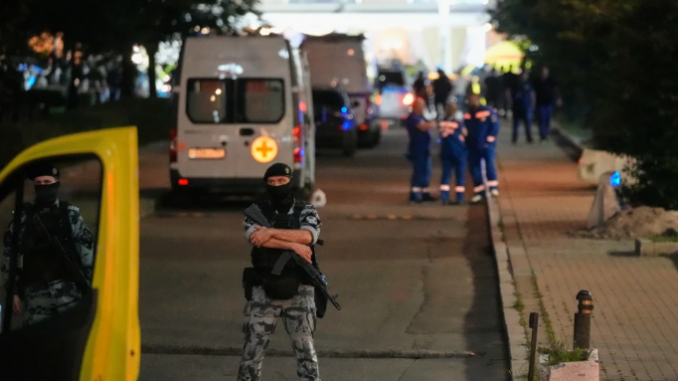
A policeman stands guard near the site where an improvised explosive device detonated at a restaurant in central Moscow on Aug. 1.Pavel Bednyakov / AP Photo
Reported by:

Cherry Meigh Timbol
News Content Editor
Published August 2 , 2026
KYIV, Ukraine — Russia’s war with Ukraine expanded beyond the battlefield once again after a deadly bombing at a high-end restaurant in central Moscow killed at least three people and injured 21 others, while both sides continued exchanging long-range attacks that underscore the conflict’s increasingly unpredictable nature. The explosion came as Russian forces maintained pressure on Ukraine through sustained missile and drone strikes, highlighting how the war is reaching deeper into both countries.
According to Russian authorities, the blast occurred Saturday evening outside the Balzi Rossi restaurant on Moscow’s Kudrinskaya Square, where a private event was underway. Officials said an unidentified woman carrying an improvised explosive device was stopped by security before the bomb detonated. The woman, a security guard, and one restaurant patron were killed, while at least 21 others suffered injuries ranging from minor wounds to serious trauma.
Emergency responders quickly sealed off the area as investigators launched a terrorism inquiry. Russian officials have not publicly identified those responsible or disclosed a motive, though reports suggest investigators are examining whether the explosive device was remotely detonated and whether the woman knowingly carried the bomb.
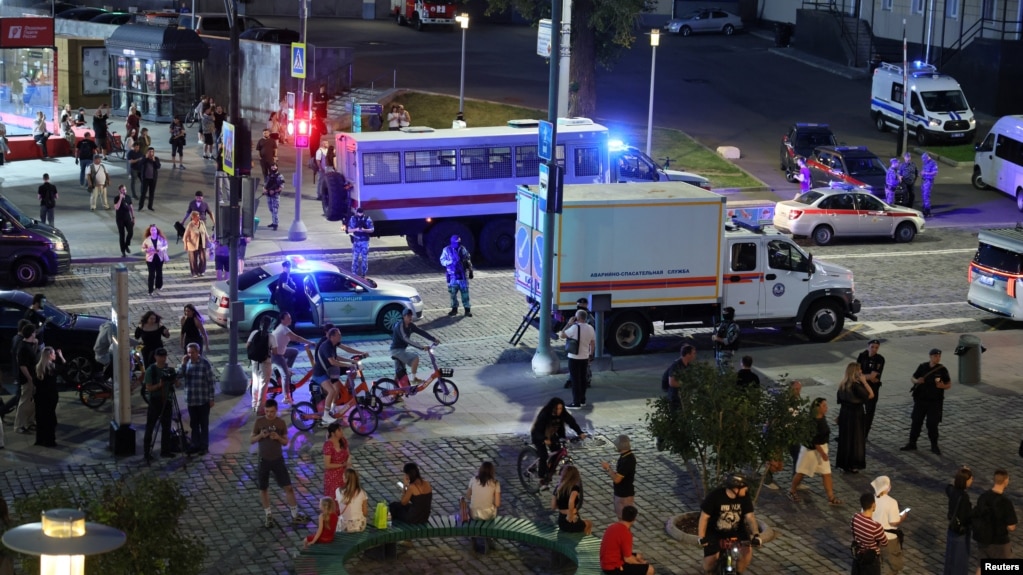
Law enforcement officers and emergency services personnel near the site of an explosion at a restaurant in central Moscow, Russia, on August 1.
Security Concerns Grow Inside Russia
The bombing has heightened concerns about security inside Russia as attacks increasingly reach areas once considered relatively insulated from the conflict. The explosion took place in one of Moscow’s most prominent districts, near government buildings and diplomatic missions, underscoring the growing vulnerability of high-profile urban locations.
Although speculation has circulated online regarding the intended target of the attack, Russian authorities have not confirmed whether any military officials or government figures were the intended victims. Investigators continue gathering forensic evidence while reviewing surveillance footage from the scene.

Moscow restaurant blast leaves three people dead. Photo: ChatGPT Recreated
Ukraine Remains Under Heavy Air Assault
The Moscow bombing occurred as Russia continued launching large-scale missile and drone attacks against Ukraine, particularly targeting Kyiv and other major cities. Ukrainian officials say repeated overnight barrages have damaged residential neighborhoods, infrastructure, and civilian facilities, placing continued strain on the country’s air-defense systems.
Kyiv has repeatedly appealed to Western allies for additional Patriot air-defense systems and interceptor missiles, arguing that enhanced defenses are essential to protecting civilians from Russia’s growing use of ballistic missiles and long-range drones.
Conflict Expands Beyond the Front Lines
The latest developments illustrate how the Russia-Ukraine war has evolved into a conflict extending far beyond traditional front-line combat. While Ukraine continues striking military and logistical targets inside Russian territory using drones and other long-range capabilities, Russia has intensified aerial bombardments against Ukrainian cities, increasing risks for civilian populations on both sides.
Diplomatic efforts to end the conflict remain stalled, with neither Moscow nor Kyiv signaling any willingness to scale back military operations. Instead, both countries continue investing in long-range strike capabilities while preparing for what analysts believe could be another prolonged phase of the war.
👥 Public / Political Reactions:
Russia’s latest missile barrage against Kyiv, combined with the deadly bombing at a restaurant in central Moscow, has prompted strong reactions from political leaders and the international community. The twin incidents underscore the widening security risks of the Russia–Ukraine war, as both countries face escalating violence extending far beyond the front lines.
🇷🇺 Russian Government
Russian authorities condemned the bombing at Moscow’s Kudrinskaya Square as a terrorist attack and launched a large-scale criminal investigation to identify those responsible. Officials vowed to strengthen security measures while refraining from publicly attributing responsibility as the investigation continues. At the same time, the Kremlin maintained that its ongoing missile and drone strikes against Ukraine are aimed at military and defense-related targets.
🇺🇦 Ukrainian Government
Ukraine has not claimed responsibility for the Moscow explosion. President Volodymyr Zelenskyy and senior Ukrainian officials instead focused on condemning Russia’s continuing missile and drone attacks on Ukrainian cities, renewing appeals for additional Western air-defense systems—particularly Patriot missile batteries—to better protect civilians and critical infrastructure.
🇺🇸 United States
U.S. officials have continued monitoring developments closely while reaffirming support for Ukraine’s defense. Washington has also expressed concern over the continued escalation of the conflict, emphasizing the need to protect civilians and maintain close coordination with allies on future military assistance.
🇪🇺 European Allies
European leaders condemned Russia’s continued attacks on Ukrainian population centers and reiterated their support for Ukraine’s sovereignty. NATO members stressed the importance of strengthening Ukraine’s air-defense capabilities while also expressing concern that the violence is increasingly affecting civilian areas on both sides of the conflict.
🌍 International Community
International organizations and humanitarian groups voiced concern over the continued escalation of the war, warning that attacks on densely populated urban areas are increasing civilian casualties and humanitarian needs. Many governments renewed calls for restraint, the protection of civilians, and renewed diplomatic efforts, even as prospects for an immediate ceasefire remain limited.
⚠️ Resulting Effects:
The deadly bombing at a restaurant in central Moscow, coupled with Russia’s continuing long-range attacks on Ukraine, has underscored the expanding scope of the conflict. The incidents have heightened security concerns, reinforced military priorities on both sides, and added new uncertainty to an already volatile war.
🚨 1. Security Concerns Inside Russia Have Intensified
The bombing in Moscow exposed vulnerabilities even in the Russian capital, prompting authorities to tighten security around public venues, government facilities, and high-profile events. Investigators continue searching for those responsible while reviewing possible security lapses.
💥 Effect: Russia is expected to strengthen domestic counterterrorism measures and increase surveillance to prevent similar attacks in major cities.
🏙️ 2. Civilian Safety Has Become an Even Greater Concern
The Moscow explosion and Russia’s continued missile and drone strikes against Ukrainian cities demonstrate that civilians on both sides remain increasingly exposed to the conflict. Urban centers continue to face growing risks from both aerial attacks and acts of sabotage or terrorism.
⚠️ Effect: Public anxiety is likely to increase as governments expand emergency preparedness and security measures in populated areas.
🛡️ 3. Ukraine’s Demand for Air-Defense Support Has Grown
Russia’s sustained missile and drone campaign continues to place enormous pressure on Ukraine’s air-defense network. Ukrainian leaders have renewed calls for additional Patriot systems and interceptor missiles to better protect cities and critical infrastructure.
🎯 Effect: Strengthening Ukraine’s air defenses is expected to remain one of Kyiv’s top military priorities and a key focus of discussions with Western allies.
🌍 4. International Attention Has Shifted Toward Escalation Risks
The combination of a deadly bombing inside Moscow and ongoing attacks across Ukraine has reinforced concerns that the conflict is becoming increasingly unpredictable. Governments and international organizations continue monitoring developments amid fears of further escalation.
🤝 Effect: Diplomatic efforts may face additional challenges as both sides prioritize security and military operations over negotiations.
📈 5. The War Continues to Expand Beyond the Front Lines
Long-range missiles, drones, and attacks deep inside both countries have become increasingly prominent features of the conflict, reducing the distinction between combat zones and civilian areas.
🌐 Effect: The conflict is expected to remain highly dynamic, with continued risks of strikes on strategic infrastructure and major urban centers.
🕊️ 6. Prospects for a Near-Term Peace Agreement Remain Limited
Neither Russia nor Ukraine has indicated a willingness to significantly reduce military operations, while investigations into the Moscow bombing and continued battlefield activity are likely to further complicate diplomatic engagement.
🧭 Effect: Unless meaningful negotiations resume or battlefield conditions change substantially, the war is likely to continue as a prolonged conflict marked by sustained military pressure and recurring security threats.
🔮 Future Outlook:
🧩 Bottom Line:
SOURCES: SKY NEWS – Three killed in Moscow restaurant blast after improvised explosive device detonates
BLOOMBERG – Bomb Kills Three, Wounds 21 at Central Moscow Restaurant
FRANCE 24 – Three people killed in Moscow bombing
AL JAZEERA – Moscow restaurant bombing kills three