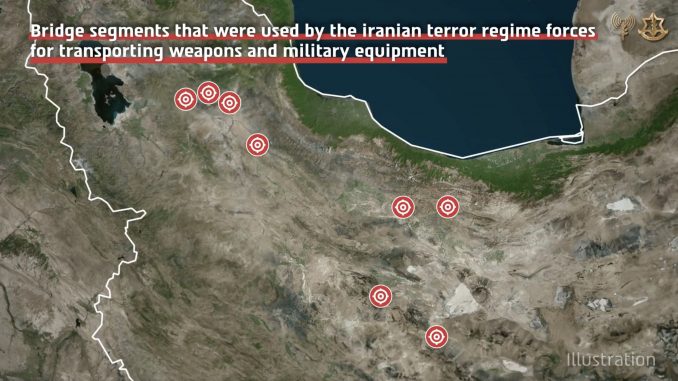
Israel has reportedly obliterated eight additional bridges and key rail links across Iran, targeting critical infrastructure used by the regime to move weapons, troops, and military supplies.
Published April 7, 2026
TEL AVIV — The Israeli Defense Forces announced on Tuesday that they carried out a series of strikes targeting eight key bridge segments across Iran, dealing a significant tactical blow to Tehran’s ability to move weapons, personnel, and military equipment amid an escalating conflict with the United States and its allies. The operations, confirmed by Prime Minister Benjamin Netanyahu, occurred as diplomatic deadlines expired and Iran continued to defy demands to reopen the Strait of Hormuz.
The bridges — located across multiple strategic locations including Tehran, Karaj, Tabriz, Kashan, and Qom — were used by Iran’s Islamic Revolutionary Guard Corps (IRGC) to transport weapons, supplies, and forces, according to an official Israeli military spokesperson.
Targeting Transportation Nodes Used by Iranian Forces
In a statement, the IDF said the strikes were designed to disrupt the regime’s ability to rapidly reposition missile launchers and other combat systems that have been used to threaten Israel, U.S. interests, and regional allies. Officials emphasized that the bridges struck were integral to Iranian military logistics.
Prime Minister Netanyahu said the operations “targeted the railways and bridges used by the Revolutionary Guards,” underscoring a sustained campaign aimed at degrading Iran’s ability to wage war. The military also hit a petrochemical facility in Shiraz believed to support the regime’s weapons production.
Conflict Escalates as Diplomacy Falters
The strikes came as a United States‑imposed deadline for Iran to reopen the Strait of Hormuz expired with no compliance from Tehran. President Donald Trump had warned that failure to meet conditions — including reopening the waterway critical to global energy shipments — would trigger expanded military action against Iranian infrastructure such as bridges and power plants.
Although diplomatic backchannels remain open, Western officials have made clear that actions to restrict shipping through the strait are unacceptable and constitute a serious threat to global energy stability and allied interests. Meanwhile, Iran has shown no willingness to ease its blockade, further fueling coordinated U.S. and Israeli pressure.
Strategic Impact on Iranian Military Operations
Bridges and transportation infrastructure are widely recognized by military analysts as dual‑use targets — essential for civilian life but also crucial for moving heavy military hardware. By striking these nodes, Israel has significantly complicated Tehran’s internal military logistics, potentially slowing the distribution of weapons and reducing the effectiveness of missile and drone strikes against allied targets.
The IDF emphasized that precise munitions and aerial surveillance were used to minimize civilian harm where possible, although the full extent of collateral damage has not been independently verified.
Regional and Global Reactions
The latest military actions add to a rapidly intensifying situation in the Middle East, with global markets responding to heightened risk in oil markets and international leaders expressing concern about civilian impact. Critics of the strikes have labeled them an escalation that could draw the region deeper into conflict, while supporters argue that targeting regime military capacity is necessary to protect allies and reduce Iran’s ability to wage coordinated assaults.
Iranian state media has condemned the strikes, but the regime’s continued defiance underscores a conflict that now encompasses military, economic, and diplomatic fronts.
🔍 Critical View: Israeli Strikes on Iranian Bridges Highlight Strategic Necessity and Regional Security Risks
Israel’s recent strikes destroying eight key bridges in Iran represent a calculated military move to disrupt Tehran’s ability to transport weapons and personnel. While some critics decry the escalation as provocative, a strategic lens shows these operations are aimed at degrading Iran’s military infrastructure, safeguarding allies, and enforcing international norms. The campaign underscores the delicate balance between decisive action and global diplomatic fallout, illustrating the stakes of confronting a regime with aggressive regional ambitions.
Key Topics & Critical Angles
1. National Security and Military Strategy
By targeting critical transportation nodes, Israel has directly impaired Iran’s capacity to mobilize missiles, drones, and military supplies, reinforcing the principle that protecting national and allied security sometimes requires preemptive, high-impact operations.
2. Diplomatic Leverage and Deterrence
The strikes strengthen Israel’s and the U.S.’s bargaining position by demonstrating credible military options against Tehran. It sends a clear signal that continued defiance or aggression carries measurable consequences, applying pressure on Iran without waiting for further provocations.
3. Civilian Risk and Collateral Considerations
While infrastructure attacks inevitably carry some risk to civilians, Israeli forces reportedly employed precision munitions to minimize casualties. This approach reflects a balance between operational effectiveness and adherence to ethical warfare standards, a critical factor in maintaining international legitimacy.
4. Regional Stability and Global Implications
Disrupting Iranian military logistics may prevent broader escalations, including missile strikes on Israel, U.S. bases, or Gulf allies. Analysts note that such actions also impact global energy markets, given Iran’s position in shipping lanes like the Strait of Hormuz, highlighting the intersection of military, economic, and geopolitical security.
5. Long-Term Strategic Consequences
The strikes serve as a precedent for targeted infrastructure campaigns in asymmetric warfare scenarios, emphasizing the importance of precision, intelligence, and decisive action in limiting adversary capabilities while deterring future aggression.
👥 On the Ground: Israel’s Strikes on Iranian Bridges Stir Tensions and Regional Alert
As Israel carried out precision strikes on eight strategic bridges in Iran, military observers, civilians, and regional officials witnessed the immediate effects of a targeted campaign designed to degrade Tehran’s military mobility. On the ground, the operation has sparked a combination of heightened alert, tactical adjustments by Iranian forces, and a close watch from neighboring countries. The situation underscores how decisive military actions can shape both battlefield dynamics and diplomatic pressures in a volatile region.
Key Topics & On-the-Ground Angles
1. Military Readiness and Response
Israeli Defense Forces reported a coordinated operation involving precision airstrikes and intelligence surveillance. Military sources on the ground emphasize that Iran’s attempts to repair or reroute logistics were slowed, demonstrating the immediate tactical impact of targeting infrastructure critical to military operations.
2. Civilian Awareness and Safety Concerns
In Iranian cities near the strikes, residents reported disrupted transport routes, temporary shortages, and heightened military presence. While civilian casualties appear minimal due to the targeted nature of the strikes, the events have sparked concern among local populations about potential escalation and safety.
3. Regional Diplomatic Reactions
Neighboring countries and Gulf allies have been monitoring airspace and shipping lanes closely. On the ground, diplomats and security teams are assessing the risk of spillover effects, retaliation, or further confrontations, reflecting the sensitive balance between military action and regional stability.
4. Strategic Messaging and Deterrence
Observers note that the strikes serve as a clear warning to Tehran, signaling that further provocations against Israel or U.S. allies could result in additional precise military action. Local military analysts view this as a critical part of deterrence strategy in a highly contested region.
5. Logistics, Supply Lines, and Operational Disruption
With key bridges destroyed, Iranian forces face immediate logistical challenges. On-the-ground reporting indicates that movement of heavy military equipment, including missile transport and drone operations, is slowed or rerouted, giving Israel and its allies a strategic advantage while pressure builds on Tehran to reconsider its military posture.
🎯 The Final Word:
The Israeli strikes on Iran’s bridges underscore the importance of decisive, strategic action to protect national and allied security. By disrupting Tehran’s military mobility, Israel has not only gained a tactical advantage but also sent a clear message that aggression against allies carries serious consequences. Moving forward, maintaining vigilance, preparedness, and the ability to act with precision will be essential in deterring further provocations and preserving stability in a volatile region.
SOURCES: THE GATEWAY PUNDIT – Israel Obliterates EIGHT MORE Bridges in Crushing Blow to Iranian Terror Regime’s Military Supply Lines and Rail Network
REUTERS – ‘A whole civilization will die tonight,’ Trump says as Iran defies looming deadline
THE JERUSALEM POST – Netanyahu confirms strikes on bridges, railways across Iran to thwart IRGC launcher capacity
GULF NEWS – US–Israel war on Iran, day 39: Key highway in Iran closed as Trump’s deadline nears; 2 hurt in Sharjah after missile incident