Published April 7, 2026
It is a question that cuts straight through the noise of modern politics—and demands a serious answer.
Why are elected officials in Wisconsin choosing to defend an individual accused of having ties to terrorism?
This is not a minor controversy. It is not a routine immigration dispute. It is a case involving allegations tied to a group designated as a terrorist organization by the United States government. And yet, instead of unified concern, what the public is witnessing is division—one that reflects a deeper fracture in how America now responds to national security threats.
The Case That Sparked the Firestorm
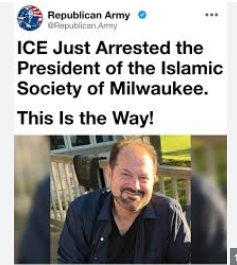
The controversy centers on Salah Sarsour, a Milwaukee resident detained by U.S. immigration authorities. According to the report, Sarsour’s background includes allegations of connections to Hamas, along with a criminal past that reportedly involves a Molotov cocktail incident and immigration-related violations.
Hamas is not an abstract label. It is a group formally designated as a terrorist organization by the U.S. government, associated with acts of violence that have claimed civilian lives. Any alleged connection to such an organization should, by default, trigger serious concern—not political reflex.
And yet, instead of caution, several Democratic officials responded with outrage—not at the allegations, but at the arrest itself.
The Political Reaction—and What It Signals
Some Wisconsin Democrats characterized the detention as unjust, framing it within broader narratives of immigration rights, civil liberties, and discrimination. Their language suggested not just skepticism, but outright condemnation of the enforcement action.
At first glance, this may appear consistent with long-standing advocacy on immigration issues. But the situation here is fundamentally different.
This is not about someone overstaying a visa. It is not about bureaucratic delays or paperwork disputes. The case involves allegations tied to national security—arguably the most serious category of concern any government faces.
When officials respond to such allegations by focusing primarily on defending the individual rather than acknowledging the severity of the claims, it sends a confusing—and to many, alarming—message.
Due Process vs. Public Messaging
To be clear, due process is essential. Every individual, regardless of accusation, is entitled to a fair legal process. That principle is foundational to the American system.
But due process does not require public officials to immediately adopt a posture of defense—especially in cases involving alleged extremist ties.
There is a difference between saying, “Let the facts come out,” and declaring that enforcement actions are inherently unjust before those facts are fully examined.
That distinction matters. Because when leaders blur it, they risk appearing less concerned with truth—and more concerned with political positioning.
The National Security Dimension
The United States has spent decades building legal frameworks to prevent individuals with ties to terrorist organizations from entering or remaining in the country. These policies were not created in a vacuum; they were shaped by real-world threats and tragic consequences.
From intelligence gathering to immigration enforcement, national security efforts depend on the ability to act when credible risks are identified.
Critics of the Democrats’ response argue that undermining these efforts—even rhetorically—can have consequences. It can weaken public trust in institutions, discourage enforcement, and create ambiguity about where leaders truly stand on issues of extremism.
And in matters of security, ambiguity is rarely harmless.
The Optics—and the Reality Behind Them
Politics is not just about policy—it is also about perception.
When public officials appear to rally behind someone accused of terrorist ties, even if their intention is to defend civil liberties, the optics are powerful. To many Americans, it can look like a willingness to excuse or minimize serious threats.
That perception can be damaging—not only to public trust, but to the credibility of the officials themselves.
It also raises a broader question: would the reaction be the same if the accused individual were associated with a different kind of extremist group? Or does the response depend, at least in part, on political narratives and sensitivities?
These are uncomfortable questions—but they are necessary ones.
A Symptom of a Larger Problem
This controversy is not isolated. It reflects a broader trend in American politics, where nearly every issue—even those involving national security—becomes filtered through partisan lenses.
Instead of unified condemnation of extremism, responses often diverge along ideological lines. One side emphasizes enforcement and prevention; the other emphasizes rights and potential overreach.
Both perspectives have value. A nation must protect both its security and its principles.
But when one side of that equation is ignored—or dismissed—the balance collapses.
The Risk of Eroding Public Confidence
Perhaps the most significant consequence of situations like this is the erosion of public confidence.
Americans expect their leaders to take threats seriously. They expect clarity, consistency, and a commitment to safety that transcends politics.
When those expectations are not met—when responses appear selective or politically driven—trust begins to erode.
And once that trust is gone, rebuilding it is far more difficult than maintaining it.
What Should Happen Next
The path forward should not be complicated.
First, the allegations must be thoroughly investigated, with transparency and adherence to the rule of law.
Second, public officials should approach the situation with measured language—acknowledging both the seriousness of the claims and the importance of due process.
Third, there must be a clear reaffirmation that support for or association with terrorist organizations is unacceptable, regardless of political context.
These steps are not partisan. They are foundational.
🎯 The Final Word: A Line That Must Not Be Blurred